>What really stands out are the main qualities that Windows 95, as a product, had and that are not common nowadays. It had a memorable launch, it was honest regarding its objectives, focused on the user, objective and transparent.
Maybe it's because I wasn't paying attention to computer stuff in '95, but I found the author's focus on "a memorable launch" somewhat out of place compared to the rest of the essay.
I was barely a teenager when windows 95 launched and my father took me to CompUSA which was staying open late for the launch.
We purchased it when it was released at midnight and we then went home to stay up crazy late and install it. It was hands down the most memorable OS launch I have ever been a part of and a defining moment for my childhood.
I think the talk about the launch helps highlight that 95 was worthy of a launch, it was actual innovation and they threw it a party. However, I also agree that the initial focus on it is a bit unbalanced with what I consider the main argument later.
The launch is just a sort of introduction, whilst the qualities that made Win95 relevant are the main focus. I don't mean to say that Win95 is outstanding, but it was surely very important at launch and made a difference in computer usage. It's more about its impact than its performance over other operating systems.
I guess I'd say it this way... there was a very simple case for Windows 95 that allowed for a big launch. The innovations were obvious, and the product was clearly superior to what it was replacing (Windows 3.x).
As a thought experiment, how would you even do a big launch for Windows 10 or the latest MacOS? I like both products quite a bit, but I'm not even sure what you would launch? A big pile of marginally useful features?
To be fair, Apple does do a big "launch" every year of their new MacOS and iOS version. Not Windows 95 big but definitely an event with many people in attendance.
The Chicago build of Windows 95 was one of the most stable OSes I've ever encountered. I had a machine that ran it 24/7 with zero issues into the early 2000s until the power supply fried.
I remember never having any system with Windows 9x stay up long enough to even come close to the required uptime to test the veracity of this bug report. We tried with a machine which didn't do anything at all but even that one crashed by itself in a week or two, probably due to some network traffic it didn't like. In that time I worked as editor in chief for some IT-related magazines so we had a lab full of machines to test and got invited to all the press conferences - including the one mentioned here with Gates and the Stones. I still think the later part of that Stones' song they used were a better fit than the 'You can start me up' line:
You make a grown man cry,
You make a grown man cry
Interesting. Re stability, people bitched Windows 95 a lot, but I only encountered serious issues when 98 came out. XP was very stable... but don't get me started on Windows ME.
A lot of perceived stability issues in Windows 95/98 were actually driver issues. Back then, all drivers ran with full privilege and could bring down the entire OS if they had a hiccup. Crashes due to bugs in the graphics driver, sound driver, etc. were really common.
"most web designs out there could surely learn a lot from how Windows 95 solved so many problems by thinking about how target users would deal with their product"
They weren't thinking about it; they were actually testing it with users.
Windows 95 really made Windows better than MacOS at that time. I had to develop software for both at that time and the truth was, Windows was just better. People would defend Macs very strongly at that time, but in my experience it was because they had developed a preference.
That's a big part of the continuing appeal of Apple in spite of some of their mis-steps. My Mac mostly just gives me a working system that keeps working and is mostly devoid of crap. The crap it does have can generally be disabled.
LibreOffice is absolutely awful from an UX point of view. That’s enough to put me off personally.
If you’re an office expert you’d probably figure out how to use it, but for me I’ve only used an office suite maybe a dozen times in my life so I’m very new to it, and latest Office 2016 allows me to get started easily (the much-hated Ribbon UI works for me and is intuitive), where as I find myself Googling all the time to do even the basic stuff in LibreOffice.
LibreOffice suffers the same issues as Star Office and others alike, and I think this is a reflection of how people get rewarded by developing open source.
Adding new features gives you a lot of fame. Fixing bugs and improving things does not.
LibreOffice is a nice thing until you get really serious and your day depends on a good office suite.
MS Office is complex, full of bugs... but it has all the things in place that a power user needs. They gave a big though about the things people need. The CTRL+Y after a CTRL+X on excel is a great example of that.
I have a love/hate relationship with MS Office. I would lave to have something better... but we're still far away.
Giving you the ability to use a computer now is not the same as it was back then and that's why Windows 95 was so important. Now it takes much more to make the same impact, but the mindset has changed. Windows 10 is an improvement upon Windows 8, not a complete rebuild of it. That's something that I doubt we'll see any time soon.
>> Giving you the ability to use a computer now is not the same as it was back then and that's why Windows 95 was so important.
This is only true if you lived in a vacuum. Windows 95 was important in terms of Windows/x86 users, but let's not forget that Macs existed at this time.
Windows 95 might have been prettier than Mac OS back at that time (at least that was the view of the Windows people I knew), but it was not leaps and bounds better.
I left Mac in the mid-90s for Windows 95 not because the the UX was better in any meaningful way, but because it was what I used at work. And while 95 in my opinion was still not as good as Mac OS, it met the threshold of being "good enough".
OS/2 warp was around as well. I never used it so I can't comment on how it compared to the other OS's. There just happens to be a boxed copy on a bunch of floppies staring at me from a shelf at work.
At the time there was still a large proportion of technically literate "power users" and the OS was built with that in mind. Now your use of your computer feels like it is at Microsoft's pleasure, not yours
Windows 95 didn't really offer much in the way of anything over Windows 3.11 for the everyday user. I remember everyone complaining about how it used 2x as much RAM and made their 486/25 and 386/40 systems unusable.
Sure, the interface was a little bit better, but Program Manager wasn't terrible. The 'desktop' is probably one of the worst UI concepts developed. Multi-tasking was a little better, but 16-bit apps could still wreck stuff, and the same went for memory protection. It crashed just as damn much.
It was a lot more stable than windows 3.11 for me. You actually stood a chance of an application hang not meaning a PC reboot. That I could actually kill an application and keep the OS running was like dark magic to me at the time.
It could not be as good looking as it should, but it surely was accessible for most people, something that Windows 3.11 was not. That's what made the difference.
I remember Windows 95 being a big step up from 3.11 and its various third-party shells. I was using Xerox TabWorks prior - which was better than the default Windows 3.11 shell, but not by much. Windows 95 was a big step forward in terms of actual usability.
On 3.11 I used PC Tools 2.0 to modernize the UI (for a while, until stability issues forced me back).
It was an interesting product. Virtual desktops with drag-and-drop of windows between mini-views of said desktops, a file manager with a tree on the left instead of a flat list and with built-in zip support, and all wrapped up in a 3D look very similar to what windows 95 became. Many of its features took years to land in windows proper. It was a sort of vision of the windows that never was.
>Windows 10 will be our best enterprise platform ever and will enable our enterprise customers to be more productive than ever before, simplifying management and deployment for IT and working seamlessly with existing enterprise apps.
Quote from the Windows 10 launch that the writer is complaining about
>Our Product Design Process ™ includes multiple stages like benchmarking, UX, UI design, design of the technical architecture and development of the project plan.
>We apply the Software Development best practices and operate with a quality mindset.
Quotes from the website of the company that wrote the article.
It seems hypocritical to complain that the Windows 10 launch was full of dubious statements when you are doing the same thing yourself.
>It had a memorable launch, it was honest regarding its objectives, focused on the user, objective and transparent.
Really? This is your argument for why we should look to Windows 95 for inspiration? Who cares about whether a launch is memorable? I doubt that the launch of Windows 95 is actually memorable for anyone outside of the tech bubble, anyways.
Honesty regarding objectives is a somewhat reasonable complaint but compared to Windows 10 I don't see why someone would say that 95 was more honest about its intentions. They seem to be making this a dig at Facebook but I don't see why Facebook should be compared to an operating system in this respect.
I honestly have no clue what they mean by saying that Windows 95 was objective. Transparent is pretty much the same as "honest regarding it's objectives". Focused on the user is a good thing but they haven't made a case that today's products aren't focused on the user.
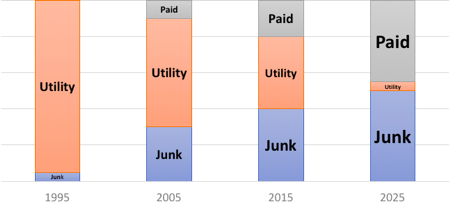
This chart seems to be saying that computers today have less utility than a computer from 1995 running Windows 95. I don't think I even need to describe why that notion is ridiculous.
For those of you that came to the comments without reading the article, don't bother. It's just a poor attempt at marketing by some UI design company.
Hypocrisy on the side of author is a logically false argument about the actual content.
I can be a murdering psychopath and express in my memoirs from prison that while I love killin', murder is immoral. Murder is still widely accepted as being immoral regardless of who asserts the opinion.
That aside I found the article's author heavily corralled observations to support his opinion.
> I’m not trying to compare operating systems with social media or mobile applications,
Yes, yes you are.
> I’m not saying we should solve every UI and UX issue with a start menu
I find it hard to actually understand what the author is really saying, perhaps he/she is saying nothing at all. The irony about substance and honesty isn't lost on me.
I agree that hypocrisy doesn't refute their argument but it does demonstrate that the author themselves either doesn't believe what they're writing or they have some other unknown reason for being hypocritical.
Seeing as no other reason was expressed in the article, I am comfortable taking the hypocrisy as a sign that the they don't believe what they're writing. In my experience, this usually means they are trying to sell me something.
They're not all the way dead yet. Sublime text seems to be very transparent, in a 90's software sense. Pay some money, get some software, keep it forever. I'm sure there are other examples out there too. It does seem unlikely that any software like that will be as widespread as Windows 95 was, though.
I won't comment on everything, because we all are entitled to have an opinion, but I don't think you took the time to read all the way through the article. Maybe you find it a waste of time, maybe you were simply not interested, and that's ok in either case.
Anyway, I wasn't comparing computers and operating systems from 1995 to what we have today, regarding anything else than a few characteristics like objectivity and transparency.
We never had so much concerning technology and it's impossible to compare whatever was done a few decades ago with what we have now. However, regarding the mindset that surrounds a product launch, I think that we are moving in the wrong direction for some time now.
Imagine if the chart that you've posted here concerned video games, for instance. Wouldn't you agree it makes sense? The same applies to applications, to smartphones, web services... etc.
I don't think it's absurd, but you're allowed to think differently.
I did read the entire article. Most of it more than once as I went looking for quotes to include in my comment.
I get that you weren't trying to say that we should switch from a modern OS to one from the 90's. You make that clear. However, you absolutely spent most of the article comparing Windows 95 to modern day software.
>Take the launch of Microsoft’s latest version of their operating system, Windows 10, for instance. No music, no comedians, no party, no fun and a lot of dubious statements.
>I’m not saying we should solve every UI and UX issue with a start menu, but most web designs out there could surely learn a lot from how Windows 95 solved so many problems by thinking about how target users would deal with their product.
>All 19MBs of Windows 95 consisted on useful tools that you could expect from a computer. There was no Cry Translator or Electric Shaver app — wonders of the modern day, available on any smartphone — as it was focused on a few objectives only.
>Imagine if such a strange object as a phone that could only make calls existed. That would be the equivalent of Windows 95 on a computer back then. It had everything you ever needed from it, without the unnecessary waste of space.
>What really stands out are the main qualities that Windows 95, as a product, had and that are not common nowadays. It had a memorable launch, it was honest regarding its objectives, focused on the user, objective and transparent.
The problem I have with the chart is not that is shows junk and paid increasing - it's that it shows the utility decreasing. As a percentage of the junk/paid/utility trifecta, I might agree that utility's percentage is going down over time but the absolute quantity of utility has increased an insane amount in the last 23 years. Your chart does not show that, at least not very clearly.
This quote is what precedes the graph:
>Imagine if such a strange object as a phone that could only make calls existed. That would be the equivalent of Windows 95 on a computer back then. It had everything you ever needed from it, without the unnecessary waste of space.
Phones like that do exist. You can get one for your house still. If you're willing to accept texting as a feature, you can get a cell phone like this. You seem to be arguing that such a device is somehow superior to an iPhone or my Pixel because it doesn't have the "unnecessary waste of space". You completely gloss over the fact that the utility section of the 2015 graph should have things like a web browser, Google or Apple Pay, Uber, Slack, Netflix, Spotify, GrubHub, and many others in it which make it substantially bigger than the 1995 graph.
Concerning the phones, I do know and I do own still a phone like that, I was just being sarcastic.
I believe that the "free" utility is decreasing, leaving space for some junk no one really uses (any smartphone comes with dozens of functionalities that we'll never use but are paying for) and paid features. These last features add utility, but for some reason, they are not included originally.
When I bought my first computer, with Windows 98, it came with Microsoft Office, Photoshop and a few other "free" tools. I've paid for the computer and those additional features were already there. It's added value that you now have to pay for and that's not only Microsoft's responsibility (at least, concerning Photoshop).
The same way you have to pay for several of the apps you've listed, such as Uber, Netflix, some Google services, Spotify premium... I don't recall the existence of "premium features" for what I used in 1995, but Spotify is the perfect example of what I illustrated in the graph.
The free version adds some utility, the paid version increases its utility and there's some junk in between that no one really listens to.
I kind of agree with you on this, but I don't think Spotify is a good example. It's not like the 1995 equivalent of Spotify was free unless you were pirating all of your music. Uber and Netflix are similar in that they replace taxis and cable TV respectively.
Anyways, if you can, I'd suggest putting another paragraph above or below the graph in the article explaining what you've said in this comment. I did not get this point from reading the article and I think a lot of other people will also struggle with it.
Well, I don't think there's a good equivalent of Spotify in the 90s, people just bought or downloaded what they wanted to hear. My point is that now we have this "free" software that, sure, you can download for free, but you'll need to pay if you want to use all its features.
I will provide an additional explanation in the text to clarify this part. Thanks for your feedback!
Not to talk specifically about Windows 95, but older is better in regarding that until Windows 8 desktop composition could be turned off, which is a major source of latency [1]. I surely do miss that.
If anyone had told me that Windows 95 A didn't play well with SCSI (Adaptec AHA-2940AU and a Teac CD-R 55s) that would have save saved me like 20 reinstalls. Yeah, maybe having access to the internet would've also worked. Also kind of interesting that I didn't have to google for these 2 exact product names after what, 20 years? :)
While it might be true that the step from Windows 3.11 to Windows 95 was more of an improvement for Windows-users (but not so much for those using OS/2, its main contender at that time) the author does seem to view history through rosy glasses. Windows 95, just like its predecessors and its successors Windows 98 and (especially) Windows ME was hampered by it being built on top of MS-DOS, remnants of which would rear their ugly heads in many situations. It was all too easy to bring down the whole system by a single malfunctioning program, Windows itself and especially many third-party drivers were riddled with bugs which would cause it to 'blue-screen', Microsoft's in itself admirable drive for backward compatibility caused many problems from earlier days to linger around. Network security was a mess, it was trivial to bring down whole office farms by sending packets with a few bits in the right positions. The lack of library versioning ('DLL hell') meant that installing program A could stop program B - or even the whole system - from working. On the topic of installing and removing programs, this was still a hit and miss affair with all programs using their own installers, many of which lacked functioning uninstallers, others which left loads of crud around.
In short, Windows 95 (and 98, and ME) was a card house built on quicksand. Windows NT 3.x made good on the promise of stability at the cost of performance and resource consumption. Windows NT 4.x improved performance at the cost of stability by moving drivers - which in earlier versions ran in user space - back into kernel space. Windows 2000 was probably the most balanced version, XP coming in second (after removing the Fisher-Price interface that is...). Given that many of the long-standing problems with Windows still have to be fixed I don't see any utility in the later versions, Windows 7 included. For those looking for an operating system to do the 'usual stuff' - internet-related activities, document processing, some multimedia - one of the more polished Linux distributions - Ubuntu, Mint, etc - is a much better choice which will save the user many a frustrating moment. If you need to run Windows-only software wine might be an option, otherwise just run it in a VM using Windows 2000 or XP if possible.
Windows on the server has been a no-starter from the beginning, this is not even worth discussing. The only reason for using it is running something like Microsoft Exchange, the question here is whether this is worth the hassle of having a Windows-based server park.
Windows NT 4.x improved performance at the cost of stability by moving drivers - which in earlier versions ran in user space - back into kernel space.
I ran NT4 for a number of years, and it remains by far my favorite windows version. Maybe it wasn't stable enough to run a server (although I've heard otherwise, with uptimes measured in years), but I have no recollection of it crashing. It was essentially a modern OS that could happily run in 32 MB of RAM, which isn't even enough these days to launch a single windows program.
My favorite desktop OS overall is BeOS R5. It was just so much fun to use. Not actually very useful, with the lack of apps, but definitely fun.
> My favorite desktop OS overall is BeOS R5. It was just so much fun to use. Not actually very useful, with the lack of apps, but definitely fun.
You should check out Haiku, then. The same old BeOS R5 desktop you remember, with modern customizeability, a package manager, and tons of ported software. :)
Windows NT eclipsed Novell Netware for small-to-medium-sized business server usage by the late 90s, and today there still exists many, many businesses that use Windows 2008, 2012, and 2016, so I'm not sure what you're talking about with the "no-starter" comment.
That is a file server and intranet server you're talking about. I'm talking about the type of server which most people around here think of when they contemplate the word 'server' - an internet-facing server, often living in a herd of such in some remote facility. Running Windows NT and its successors for file and domain services is doable and probably a good choice for those who have standardised their office environment on everything Microsoft. Outside of that environment, not so much.
Yet, again: many, many businesses do just that (run Internet-facing Windows Server installations).
You're failing to account for the fact that using Windows everywhere allows firms to leverage their codebases and developer expertise throughout their organization.
In terms of stability and performance, with work and gaming capabilities, Windows NT4 Service Pack 3 (IIRC) was the sweet spot for me. I could use my Windows NT workstation for gaming with DirectX support. It was both snappy and solid.
The sweet spot OS for me at the moment is Ubuntu MATE.
I use a Gtk2-derived desktop environment (Cinnamon/MATE/Xfce), which is heavily Windows 95-inspired in its UI, so I'd say I have the next best thing. Plus FLOSS.
> people were still trying to understand what a computer was
Did they succeed, or did we (meaning the tech industry) just change the abstractions that are presented to the use to match what they thought a computer was?
The curse of capitalism in software (and to a large extent, hardware) businesses. It provides great leaps every once in a while. If you want to call Win95 such a leap, okay, or maybe the better versions of OSX or MacOS were great leaps. You can find great leaps on the hardware side, HP's early printers, the iPhone, etc. But businesses can't sustain themselves with incremental improvements between those great leaps, so a pathology develops.
Companies tend to resort to a release schedule that packages a bunch of necessary and useful refinements with more flash, changed UI, and added partially-broken features. That ends up making the products worse by removing functionality some users depend on, making the products slower or less efficient in some cases, and requiring users to re-learn interfaces.
I believe that Windows 95 was a huge leap, but it's not the only good example we have of products that changed the game for any given industry (and computers in particular, as well).
Windows 98, for example, was a better version of the OS, in almost every aspect, but it was not as important as Win95.
Minus Windows ME Microsoft was delivering amazing updates that increased stability and added useful features in the 95 -> XP years. Then as XP started aging OS X really began to pick up steam peaking with the 2009 release of Snow Leopard. Since then we've been in a bit of a rut with both Windows and MacOS.
We are about due for something to shake things up, but I'm not really sure what that is going to be. Maybe it's Chromebooks, or tablets, but it seems like they'd have taken off already. Maybe we are just waiting for someone to drop a revolutionary release and suddenly it will be obvious in hindsight. I'm excited to see what's coming next though.
I think the revolution is happening slowly and going largely unnoticed, because it's different than we expect it to be.
Personally, I've ditched my personal laptop and moved to an LTE iPad full-time. Between native apps, web apps through Safari, and access to a remote server over MOSH I have everything I need in a mobile computing device. For "real work", I have a MBP that my employer provides... but honestly, I probably don't get enough utility from it to justify the cost. I could work at ~90% capacity from my iPad. If more people adopt my approach, in time we'll see things like full IDEs on iOS and Android that operate against a remote server.
I think Windows and macOS will continue to dominate the desktop environment for the foreseeable future and continue with evolutionary updates, but people will be using mobile phones, tablets, and eventually wearables to do more and more of what they used to do on a desktop OS. We're seeing a slow but thorough redefinition of what people see as a "computer".
I'm looking forward to the rise of AR. VR still feels like it's in its infancy to me; it's fun to play with and you can see the potential, but the real utility hasn't become apparent to the world and won't until several more iterations have happened. I believe the future will look more like Google Glass than Windows 95.


Maybe it's because I wasn't paying attention to computer stuff in '95, but I found the author's focus on "a memorable launch" somewhat out of place compared to the rest of the essay.