No user gains anything by it, this actually helps phishing sites. Oh, and it happens to help Google's AMP effort, which can now pretend to be the original site even more effectively. Time to get everyone to use Duck Duck Go, and to get rid of those Google CAPTCHAs which are an even bigger data harvesting operation than search.
Side note: For those who tried DDG in the past and were unimpressed I suggest giving it a whirl again. I kind of wrote it off a few years ago and then tried it recently and its pretty good. You may have to modify some search habits. If you enable location tracking they do anonymous localized results (can read about it here: https://help.duckduckgo.com/privacy/anonymous-localized-resu...) Usually good if you're used to typing in food choices and getting local results
I’m a happy DDG user; I think it’s close but defnly a notch below Google in search quality. Sadly, this is mostly Google having fallen off, not DDG having gotten better.
Still it’s worth it for the better website design, avoiding AMP, and the general impression that you’re not interacting with a malevolently intentioned entity.
I've been using DDG on and off for several years, and as my primary search engine for the past 2-3+. It's definitely increased in quality from the first times I tried it, and has continued to inch up even as Google has decided they care more about enabling horrendous link farms than actually returning good search results.
Same here, switched my default search engine to DDG a few months and it took only a few days to get used to it. So much that I was very surprised to discover that I know dislike Google results UI (something I never imagined could happen). I still fallback to Google for advanced search (usually technical subjects) with !g but in the majority of common searches the DDG default results are what I expect.
Seriously to all people thinking there is no alternative give it a try, I switched my family and they don’t see a difference.
I use DDG as a default search engine for a while, but fell back to google search often, because I felt that Google results are better. At some point i enabled a stylesheet which made DDG results look like google's. And the search results improved significantly. I stopped using Google search for anything other than Google maps.
The one place DDG really falls off is correlating searches with results so they do a worse job than Google at giving you what you want instead of what you search for. That is, trying to remember something and typing along the lines of "that thing with the blue guy and the explosion" is more likely to get you a good result on Google when the actual movie you wanted was "green guy and a fire".
Virtually all my searches are resolved by DDG. I should also mention that statistically speaking my searches are not particularly complicated, and many are searching for an article or tidbit I had seen before or something where I pick wikipedia as the result.
For those considering it, just please remember you can still do google searches from DDG, and imho much more smoothly. For example, I don't even know if googles date operator works anymore, and it's too slow for my taste to click the date range I want in google, so if I want google results for the last year I just do !gyear, etc.
Once you start remembering the DDG bang operators things get much smoother. Also, one more thing, DDG has a cli client that is pretty awesome if you live in the cli like I do.
I found that DDG is okay for two types of queries: common everyday topics and technical queries. For many other niche topic, it’s not good at all.
I use DDG as the default and have been doing so for many years. I still have to add !g every time I search for violin related questions. The results are often just not relevant at all.
I think DDG still has a long way to grow to be a 100% replacement for Google outside the tech and science community.
Regarding technical queries, they consistently return links to the python 2 docs, never python 3.
What I assume people do is they click on the python 2 docs then change the version on the python website. So, from bings perspective it looks like people want the python 2 links. It always frustrates me and makes looking stuff up longer than needed.
It's a default with Brave browser, and I've decided to give it a go. That was about a year ago when I first started to use Brave. Back then, some search results were poor, especially localised ones, so I've decided to use Google.
Now it's much better, some results are even better than google where better SEO trumps more relevant results.
Also, Brave has this nice feature where typing `:g<tab>[search term]` uses google for that one serach term. I use it if am not able to get good results with DDG.
I still can't leave google. Because it saves me lots of clicks and js slowness of other websites.
Most of the time I find whatever I am looking for directly on the results page like movie review, ratings, actors, related movies and many other things. It shows prices of a product on different stores directly and also related products. No other search engine does this. Bing is almost there except it does not show product prices in my country.
You're right, nowadays DDG is really not bad for satisfying everyday web search needs. On the other hand, I cannot help but switch to Google (g! at the end of the query) for anything programming related because Google just finds things that DDG doesn't.
Do we have any recourse against this monopoly, other than voicing our concerns repeatedly while they ignore us?
Can we launch a class action lawsuit against Google if they harm people by limiting consumer choice, and force us to be tracked everywhere using reCAPTCHA v3 and various other methods?
Keep in mind that not sending your data to Google is not a real option, there are several government services, health care providers and utility companies using reCAPTCHA, you personal data either gets harvested by Google, or you're barred from accessing essential online services.
What can EU and US citizens do to initiate an investigation into Google's data harvesting practices?
Gentle reminder that Alphabet is now listed as one of the biggest lobbying firms in the US. They spend tens of millions telling lawmakers what laws to write.
> Do we have any recourse against this monopoly...?
Once upon a time, Congress used to write and pass laws to protect Americans from egregious abuses of power like this. Of course, that time is long gone.
Do you honestly think removing URLs from search results is an "egregious abuse of power?" This is the company that buys credit card transactions from Visa et al. and associates them with your maps and and history for the benefit of advertisers, and you're complaining about them removing a design element 95% of people probably don't care about?
I meant Google in general. It’s yet another tiny step in a terrible direction. At this point I would love to legislate most of Google out of existence, personally.
> I don't really buy using legislation. Alternatives exist and people don't seem to care to use them.
Google is engaged in using its market dominance in one segment to gain or maintain dominance in others, while suppressing the competition. This is illegal behavior for which Google has been fined several times over the past few years.
Just consider that in past Android versions there was a hard-coded Google search bar on the default home screen that you could not remove. Google has been forced to ask users and offer a set of alternative search engines on devices with recent Android versions. Same goes for Chrome and competing browsers [1].
Right now Google Search detects the Firefox for Android user agent and serves a second-tier search experience for Firefox users on Android. They have been doing this for the past 6 years [2].
Yes it is when taken in aggregate with all of the other changes which have been hostile to users and good for their ad business. One example is how they used AB testing to justify, over the course of a decade, a slow redesign of Sponsored Results so they look nearly identical to like regular search results.
Their unethical behavior lead me to quit, divest, and delete all of my Google accounts.
Re: the phishing example, it's roughly analogous to a business refusing to put up caution signs around dangerous areas like slippery floors or where there's construction. It's such a small thing that could help prevent enormous losses from clients and yet they won't do it for shady business reasons.
> Do you honestly think removing URLs from search results is an "egregious abuse of power?"
Yes, it very obviously is. Google the search engine, and therefore Google, would never have gotten off the ground if it had hidden URL from the beginning.
> and you're complaining about them removing a design element 95% of people probably don't care about?
If so many people don't care about something so basic and crucial to not being a serf in the information age, then that makes the issue even more important, and Google's behaviour even more egregious.
Yes: minimize or stop using them. There are alternate search options. The web has very little lock-in (on the user side) compared to say desktop and mobile... make use of that.
While there's a chance the EU might do something about the behavior, I think it's safe to say that here in the US the odds of anything pro-consumer happening anytime soon are effectively nil.
300,000 users a month and we don't have any problems. Why do people think this is so critical? Just because TEH GOOGLE convinced us it is in order to push their product?
Notice that I said on the user side. I completely agree that when a web site uses various Google (or other) services you're stuck. However, the article is about Google removing URLs from search results... you can do something about that.
So basically after a few decades of using the Internet, we're now at a place where we are willing to stop using some of the most famous services we're accustomed to. Strangely, those are mostly owned by Google and Facebook.
Yes, that's the way market economies work. One of your jobs as a consumer is to recognize when your interests and a company's no longer align and be willing to walk.
Of course, but majority of people aren't informed enough about these situations and that has created a negative loop which allows these companies to exploit lack of knowledge on their customers' part in an increasing rate.
Ding Ding Ding! Google is working against their users' interests, and most of them don't realize it, because computers are still magical appliances to 95% of users.
That doesn't mitigate Google's evil, it makes it worse.
  > Keep in mind that not sending your data to Google is not a
  > real option, there are several government services, health
  > care providers and utility companies using reCAPTCHA,
  > you personal data either gets harvested by Google,
  > or you're barred from accessing essential online services.
Google is not the problem, the government services, health care providers, and utility companies are the problem. You will need to get in touch with your local ombudsman and deal with each one individually.
> Test quote. Does this line wrap? Will this line wrap? Might ever this line be found to wrap? Should it be possible, on the fringes of the browser, to wrap a line so fine as this?
The recourse you have available is writing letters to your elected representatives and if they fail to take adequate action then to vote for someone else who will take action.
US anti-trust actions have historically been triggered by abuse of market dominance (e.g. leveraging market dominance in other markets; anti-competitive behavior in a dominated market) which is not coupled to the ease of using a different service.
Ease-of-switching puts the onus on the user to recognize corporate violations of anti-trust law rather than upon the company violating anti-trust regulation.
It doesn't really make sense to presume users would or should change their behavior if a provider violates anti-trust law.
I keep seeing that “companies shouldn’t use their dominance in one area to get into another area”.
So does that mean that Netflix shouldn’t have used its dominance in DVD rentals to get into streaming and just die when another company did? Should Apple not have been allowed to use its dominance in the music/media player business to get into the smart phone business?
Antitrust was traditionally used when a company kept other competitors out. How is Google stopping another competitor from creating a search engine? The fact is that no one is forced to use Google. People can just as easily type bing.com in their browser as google.com.
In fact, the dominant desktop OS, doesn’t have Google as the default search engine and thanks to a consent decree - at least in the EU - Google cant force manufacturers of Android devices to make it the default search engine.
If Microsoft wanted to outbid Google to be the default search engine on iOS devices it could.
> It is illegal for a dominant company such as Google to use its dominance in one market in order to provide its own product an anti-competitive advantage in a separate market, the European Commission has recently decided.
> Such conduct constitutes an abuse of a dominant position and hence is in breach of competition law.
> It is not illegal for a company to enjoy dominance in a particular market. However, a company which is dominant in one market can easily use its market power to cement or further expand its dominance, or leverage it into separate markets. [0]
Regarding Netflix and Apple, the answer is "it depends". Cases are determined on a case-by-case basis.
Not sure we disagree (?). My understanding is that Google has a practical monopoly on search. This is not illegal in and of itself. Anti-competitive practices that leverage its dominance in search, however, would likely run afoul of EU and US antitrust regulations. (I'm not an attorney, and My understanding of antitrust law is at the level of layperson. )
As your parent comment wrote: "Keep in mind that not sending your data to Google is not a real option, there are several government services, heath care providers and utility companies using reCAPTCHA, you personal data either gets harvested by Google, or you're barred from accessing essential online services."
It's impossible, they track and bother you even if you selectively ignore them. It's sick that we tolerate it, you wouldn't tolerate peeping Tom's either if they promised to anonymity their data. Hey your daughter is anonymous and face blurred, there is no harm done. You can ignore all the public beaches, just opt out like that.
I think that just expressing our opinion, and doing what little we can will have an effect in the long run. Google is far from invincible - it still needs to answer to shareholders, and has (or will get) competitors and legal scrutiny.
Eventually, like previous major computer companies, its monopoly will weaken, and it will have to play a bit nicer.
That only works if the shareholders care about Google being ethical, as opposed to caring about maximizing profit. How likely do you think that is to happen? (Genuine question, not being sarcastic)
I do not expect most shareholders to act ethically. If anything, I think their drive for short-term profit is weakening Google far more than what any 'ethical shareholder' could have done or would have wanted to do.
I was arguing that Google/Alphabet is subject to the same forces that brought down the reign of other dominant companies in the software industry like IBM and Microsoft* . Eventually Google's reign will crumble too, and probably for the same reasons.
Our actions, albeit small can push in that direction, just like small actions helped to bring down others. Choosing other computer providers made IBM unable to extend its practices to minicomputers and left them vulnerable to MS. Linux played a role in denying server marketshare to MS. Popular opinion aided the antitrust cases against both MS and IBM - it is not commonly known these days there was a massive antitrust case against IBM which lasted even longer than the MS case.
* Note that both of these companies still exist and are very wealthy. I for one, do not seek to abolish Google - just to limit their ambitions to something that can coexist with others.
They could do something better than resigning: voice their concerns both internally and in public. I have yet to see a HN comment posted by a current Google employee that has criticized Google's data harvesting practices or monopolistic behavior.
They would be foolish to publicly criticize their employer. Just because someone doesn’t post criticism publicly doesn’t mean they aren’t pushing internally. In the end though, the best way to hurt them is to walk away.
Personal sacrifice is often required for things to change. Any developer who publicly speaks up about these issues may be hurting their employment prospects, not just Google employees.
Would love to switch to DDG, but it consistently gives me search results that do not contain s search term at all, even when I wrap it in double quotes.
So they give me thousands of non relevant search results.
It's actually weird to see that in a DDG x Google comparison... But yes, DDG has started giving me results with entire terms removed from the search since recently, and I have to add quotes all the time to get them back.
But at least with DDG we have to option of quoting the terms. Google is much worse at this in any way you care to measure.
No, they actually started removing even quoted terms from search like 2-3 months ago or so; as a consequence I am now looking for DDG alternatives. First Google results became bad, now DDG seems to copy the same "failure" of the "dominant player" instead of standing out and being useful.
Yes, I've found this to be the case. Today I was searching for "DVD-RAM" and most of the results from DDG did not contain the term at all, with or without quotes.
Duckduckgo claims to use 400 sources [0], so you’re probably not totally spot on.
Edit: However, that includes their Instant Answers feature, and the numbers are outdated, it’s 1600 sources, most of which are catering to an specific and tiny niche (like angular.js docs, or a dictionary of accounting terms). Main sources are Bing, Yahoo, Wolfram Alpha and their own crawler (according to Wikipedia).
> Duckduckgo uses Bing search in the back end, which is dogshit
Bing seems fine to me.
When I got a Surface Pro 4 three years ago, I decided to give Edge a try to see if it would do as my main browser, and left Bing as its default search.
Three years later, I've not felt the need to change that.
It also doesn't have the good locality of Google search. It's like a timewarp back 15 years ago when I had to put "Canada" into every Google search query to tell them I want the Canadian version of the site.
This used to annoy me as well until I realized it's a very minor inconvenience compared to the benefit of not having my location data collected every time I search.
You can enable localization on DDG, but by default it's off. Personally, I think that not tracking location is a saner default, but it is an option that you can enable.
DDG is a pretty easy switch once you learn how to use bang searches. DDG usually finds what I'm looking for, but in the rare occasion it doesn't I just add !g to the search and it takes me to google.
This gets even more powerful when you have DDG as the default browser search. I use !w in the address bar to jump to a wikipedia page when I know what I'm searching for will have one.
An even better one, something like "30GB at 20Mbit/s !wa" brings you to wolfram alpha and starts the calculation automatically.
I hate on amp because it locks pages into very heavy libraries that should really be kilobytes of html/css. It also nags me that google can do whatever they want with the content that way, completely taking control away from the publishing site.
> I also don't really understand what's wrong with data harvesting
If you don't understand why people get pissed when they're forced to get every detail of their lifes put on permanent record by google without a choice to opt out, I can't help you with that. You should probably move to china, I recon you'll like it there.
It's still regular for me but if true this will probably be the last straw for me. It's already absolutely impossible to send someone a link to a pdf you've found through google, this would make it impossible to send any link. That bloody wrapper is also a fine piece of shit. Search engines should link to content, not appropriate that content, hide who supplies it or mess with the links.
"MDDS was introduced to several dozen leading computer scientists at Stanford, CalTech, MIT, Carnegie Mellon, Harvard, and others in a white paper that described what the CIA, NSA, DARPA, and other agencies hoped to achieve."
That link is cool, I wasn't aware the CIA has a literal VC firm!
Still, I'm skeptical. The link doesn't really say In-Q-Tel influenced Google directly, I especially don't see evidence for influence during Google's early years.
It appears Keyhole (a company G acquired in 2005, who's software became Google Earth) was funded in part by intelligence money. Google went public in 2004, so they were already beholden to public shareholders by the time of that acquisition.
Besides, Keyhole just made good mapping software. DARPA funds lots of robotics labs, but I wouldn't say Berkeley and CMU are any more a part of the US intelligence apparatus than I am as a tax payer. Some work they do has utility to the gov, so the gov funded it. That doesn't make their efforts direct intelligence work.
It annoys me how any mention of the In-Q-Tel relationship to certain tech firms is met with derision and downvotes and accusations of crazy conspiracy theory. It's as if NSL's and Prism were just a blip on the radar people want to pretend isn't happening anymore. Snowdens docs though released in 2013 were from 2007! Imagine how much more embedded and pervasive the system is (which probably just got a name change as is standard when programs similar are revealed to the public).
Add in whatever the modern version of Operation Mockingbird is and those companies at the very least are sure to have been infiltrated after the fact. Probably willingly. You'd be surprised how servile people get when men in black suits with 3letter badges show up and say the words "National Security". All these factors and more in aggregate make the probability that there was government influence and involvement highly likely.
I was trying to find the URL of Crate and Barrel Canada yesterday on Mobile on Google and I found myself dropped into some google clickbait hell...
I ended up in their google maps product on mobile and was clicking around between their reviews, their location on google maps, the opinions of other google users about what they thought crate and barrel was good at, pictures of crate and barrel stores, etc...
But I could not find their websites URL... not in what I would consider a reasonable amount of time at least.
Obviously I found it in the end.
But I couldn't help but think that Google really doesn't want me even going to the actual URL.
They want me to call and drive to the store using their phone and their google maps product, and leave a review on their platform, growing their company's value for them.
Crate and barrel and my original intentions be damned.
That is a very interesting insight. To take your insight and to rephrase it a bit: any two sided marketplace that trades on the time that you are engaged with it is not served by giving you what you need right away.
Thought experiment on funding models for dating sites, assuming omniscience (exclusively regarding relationship longevity, and success rate of services):
- Monthly: Incentives variable, but generally low quality results (for slot machine psychology.)
- For each match/hookup/"real" relationship: Incentives results that produce relationships that last exactly long enough to be considered a match/hookup/"real" relationship.
- One-time upfront: Incentivize finding the best available candidate ASAP in order to save server costs.
- Monthly, cost propositional to success rate: Optimizing for some specific length of relationship that someone calculated to be optimal.
There are most likely other funding possibilities, and I've most likely misunderstood some rule of economics. Note that none of these optimize specifically for happiness in relationships, only for longevity.
On DuckDuckGo, when I searched for "Crate and Barrel Canada" (without the quotes), their home page (www.crateandbarrel.ca) showed up as the first search result:
On Google for me, the link is missing. Google also does this fun thing where when you click on the link it invisibly changes in the background to a Google-wrapped URL.[0] If you right-click on the link and select "copy link location", you won't get the result you want, you'll get gibberish.
So it proves that you can use DuckDuckGo to immediately get the link with no fuss, and that Google Search is increasingly not designed to facilitate that kind of interaction.
Google rewrites URLs to track clicks and improve search, which is mildly annoying but not quite nefarious.
The links obviously works, but if you want it to look nicer, why not just click and get the URL from the browser? That might even be faster depending on device and keyboard/touchscreen/mouse setup and usage.
Sometimes the target site has been rearranged, the link immediately redirects to an unhelpful generic page, and the Googlefuscated link doesn't work in the Wayback Machine.
This is easy enough [for me] to work around with browser developer tools on the desktop, but a PITA on, e.g., iOS, where these are not readily available.
Google could solve the problem without sacrificing telemetry by overriding the context menu for the link with an option to "show original link".
I get the exact same result in Google, so I'm not sure what this proves.
It proves that you don't understand how Google works.
Each search is custom to the person, profile, IP address, geolocation, search history, surfing history, purchase history, social media, and a thousand other trade secrets that Google holds. No two searches are the same.
This is why when Sally in Accounting searches for something on her work computer, and Mike in Facilities searches for the same thing on his phone they get different results.
I doubt OP had never heard about individualisation. It's just generally overrated.
There is little doubt that Sally, Mike, and everyone else, will get that website as the first result for that query on desktop, unless they specifically block English-language results.
Honestly at this point I'd be more inclined to add the Google domain set to PiHole and treat them as hostile. Except I would have to greenlight those damn CAPTCHAs.
Adding an addon feels more like gaslighting myself that they're not abusive really. Was bad enough when they "innovated" search by adding a JS redirect to every visible URL so what you saw wasn't what you got - just what you eventually got after they've logged and tracked you.
I switched to DuckDuckGo a while ago, took a little while to get used but as it's my default search engine I've got used to it. The funny thing for me is now google's search results look strange to me as I've not kept up with all their "tweaks/changes".
I think best thing is switch default search to a new engine to get used to it, takes a little adjusting but worthwhile.
I switched to DDG what seems like years ago (at least two, maybe more). I cannot fathom how horrible the UI&UX of Google search results are now. Stuff and things everywhere, ads hidden here and there, images, lists inside search results.
I just want a plain list of websites, thank you. If I want images or videos or news, I'll click that handy tab you provided for me...
It's the same for me. I tried DDG maybe a year ago..and couldn't stand it, I found it too lousy. But now I'm trying again and this time it's slowly sticking in. Idk if it for better or my tolerance against Google decreased.
It did much the same. I let my Google cookies expire on Firefox when they broke Gmail on everything but Chrome. Google search results became even crappier and I got fed up enough to permanently switch to DDG.
For what it’s worth, I switched to ddg a couple years ago and haven’t found the same thing. If I ever search on ddg and don’t get what I want I just append !g to the search and it sends me to google anyway.
This is the last straw for me as well. I only used Google for search and never had an account anyway, so it's not even a hassle. Their results are slightly better than DuckDuckGo, but I'll take the productivity hit.
This is openly hostile to the foundation of the web. They aren't even bothering to pretend anymore.
well, not just the search engine has been acting weird.
Chrome doesn't show http/s or www in the address bar anymore. this made me incorrectly communicate a URL yesterday. for example www.news.ycombinator.com and news.ycombinator.com look exactly the same in Chrome's address bar. no idea why they made that decision...
just yesterday i noticed that hovering some hyperlinks doesn't reveal the linked URL at the bottom of the screen. so weird...
Have been experiencing the new Google search for several weeks now. It is absolutely horrible and severely confusing. For me too this is the last straw so I started migrating away from all Google products.
Whether this claim is true nor not, Google is able to pull such a move due to its monopoly. Most of us are against monopolies but don’t care about Google’s central position on our precious Internet. We should act up though. One day, it could be too late.
I’ve been using DDG for around a year now after numerous failed attempts in the past. I, too, had been frustrated with some search results, but I don’t miss Google anymore at all thanks to the bangs feature.
It is not obvious but DDG has a learning curve. You should re-learn the practice of “Googling skill” that we had to have years ago. I could even guess which queries DDG would fail to bring meaningful results before hitting enter now. In these cases I add a “!s” bang for https://startpage.com — a privacy conscious Google proxy.
DDG bangs are especially useful on iOS, where you could type a query from any page and only have 3 options: Search in the Web/App Store/Maps. If the search engine is DDG though, you could search your query in any website you know its bang with just a single step.
There’s a difference between being the dominant player in an industry and having a monopoly. Consumers overwhelmingly prefer Google because it’s the best search engine, period. The second that changes, users will switch to something else.
Remember that AOL, Yahoo, and MySpace “monopolized” the internet not that long ago. There were hysterical articles in the mid 2000s speculating on whether or not these companies had a “cyber monopoly”. I doubt you think those companies are still the dominant players on the internet...
I think it's a little too early to come to a full conclusion here. Google is constantly testing layout changes in SERPs and it seems like OP ended up in a test. The thread is 4 weeks old and I haven't seen or read anything on these changes anywhere but on this thread.
I still think Google's general direction is clear with more webmaster incentives for structured data, amp and also Google just straight up answering questions (nutrition, sports etc.). But this example doesn't prove that Google is removing URLs from SERPs, it is one version of many that are tested constantly to improve CTR and other metrics.
It's less the specifics and more the trend. Google's direction is, as stated elsewhere, to be seen as the source of information - not a route to it. As you note, they're incentivising structured content - which means they can appropriate it and present directly rather than providing a link to the originator.
No doubt some will find it helpful (as with AMP). Some will find it unacceptable appropriation. I'm most definitely in the latter camp. I don't use Google search anymore, having transitioned to DDG 2+ years ago. I rarely find situations where reverting to Google is necessary, and when I do, a `g!` in DDG is as close as I get.
I realise I may be in a minority, but as far as I'm concerned both Google and Facebook have jumped the shark. They're become corporate behemoths, a malaise that seems to come to all companies of a certain age and scale. They've lost focus on providing useful, innovative services for real people. Instead, they're all about "shareholder value". Both are ripe for disruption.
I have recently noticed that to my eyes, Google search looks like physical junkmail marketing "Magazines".
Google funnels me to products, services, and affilate marketing blogs, advertisements and their own paid ad placement. To Google, the internet is shopping, and maybe a least-common-denominator social network or two. Garbage.
Google feels like going to the Mall anymore. Super sad, but as you have noticed the silver lining is the fabulous service of duck.com.
If I were paying for google search with a credit card, I would cancel, and then call to stop payment. Too bad they never asked for my money.
Hit me today. I hate it. I get URLs all the time for research, writing and my own database of info.
Honestly, I was willing to put up with BS so long as I actually got the data I was looking for. Now that I do not get it, and am forced into every result being turned into "I'm feeling lucky", I now have to abandon Google search.
This is a bigger deal than they want it to be.
Forced trust scenarios never go well. Abuse = profit = abuse.
I’ve seen this new presentation too. At first I didn’t think much of it. The version I saw was slightly different. It was using carets to divide the URL, both for domain as well as for directories. (So carets were substituting for ford and slashes; this goes further).
First of all, I hope this is just an tiny experiment or better a hoax, and won't be widely adopted. Google deserves constant critique, but they also deserve credit as a company that often promotes the open way first (for example, schema.org as a way anyone can describe their information, which can be ready by anyone).
But if it's not an experiment, I'd start putting my energy into moving away from Google. In the AltaVista era, just before Google, there was a company called Real Names, which wanted to bypass intentional DNS and use searches as direct keywords to domains. Since many people use Google to go to everyday sites, just taking the top result each time, this is in effect what Google would be doing with this change, since one would have to actually go to the site to verify it. Which would be great for ad impressions, but terrible for the consumer experience, IMO way too random for Google to seriously consider it. The next step would be to remove URLs from browsers. But that would be quite a change in direction from good intentions.
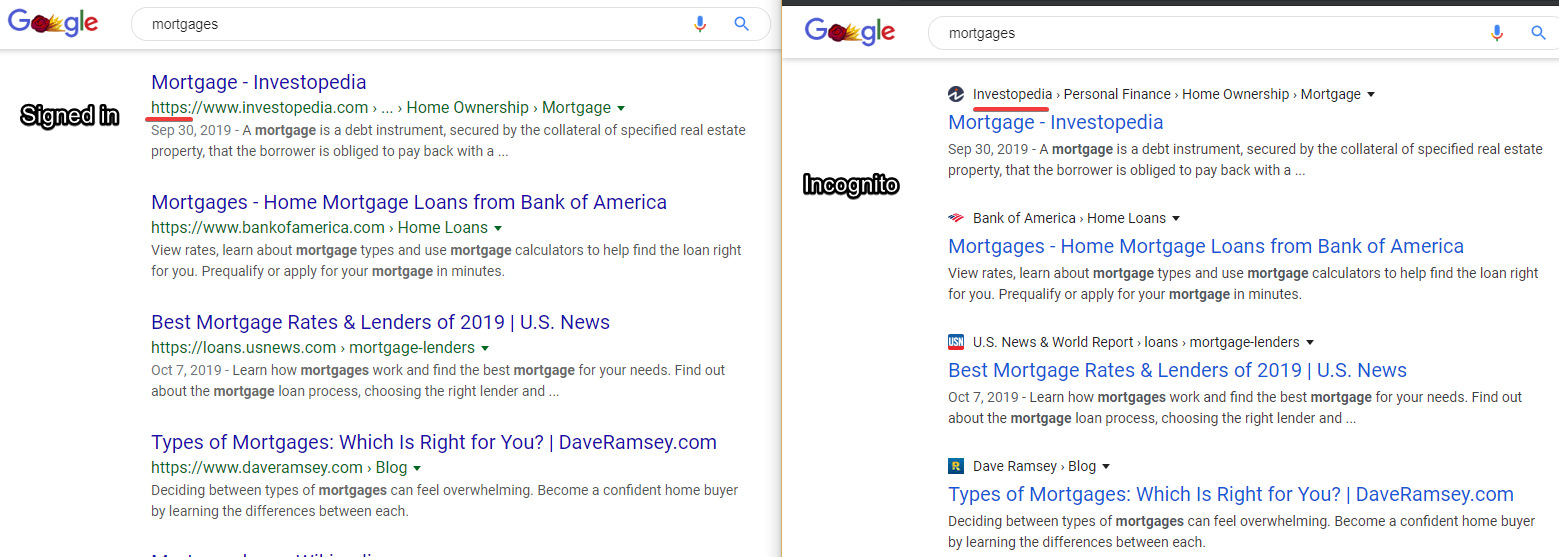
I think it's more "test with users but keep programmers/power users happy". Old accounts (or maybe accounts they deem to be 'power users'?) still see the green http/s links, and my search for "mortgages" doesn't show the favicons like the reddit suggests.
This happened with the little icons next to the "all/news/images" tabs at the top a few months ago, I didn't see them in my G search but incognito showed them.
I tried the same search in both and got the same results (links displayed in both). Maybe you just happened to get into a different A/B bucket when you opened incognito
Google very, very rarely promotes the open way first, and when they do it's step 1 in embrace, extend, extinguish. They have no good intentions. I don't think they ever did, they just had "do no evil" branding until the evil got too obvious to ignore.
Speaking as an employee at Google (but not for Google; opinions are all my own), I will offer you this anecdote:
I have met a lot of people in my career who are motivated to do work for the public good in order for the whole world to benefit (e.g., standards, open source, public speaking/education etc.) and not just one company. I met the vast majority of those people after I joined Google, and many of the others had previously worked at Google.
As a lowly engineer, it is difficult for me to speculate about the true motivations of upper management. But, I do feel confident saying that I work alongside a lot of people who are not motivated by evil or "embrace, extend, extinguish" mentality. My colleagues have good intentions, and they act on them.
That said, Google is a big place. It's so big that usually I only hear about user-hostile things like this from the news. I personally find it demotivating and sad, because it undermines the good work that I know is being done elsewhere in the company. It seems like the latest in a long string of incidents, and it probably won't be the last.
So, take that for what you will. But, please also consider that it may not be as binary good/evil as you make it sound.
As a counterpoint, consider that just because good people work there does not mean that the company isn't evil. I'm sure there are NSA employees who are nice folks, but that doesn't mean that the organization is good.
Even the originator of 'embrace, extend, extinguish' had good people working for them. That doesn't mean that early 2000s Microsoft wasn't a fairly evil organization. To Natella's credit, they have radically changed, but please re-read your comment and consider that it doesn't actually prove anything about Google as an organization.
> As a counterpoint, consider that just because good people work there does not mean that the company isn't evil.
This isn't a comic book or a Marvel movie. Companies are just that, companies. They're incentivized to make money. Google is as evil as BP, Oracle, Microsoft, Apple, Ford or Tesla.
Instead of doing comic book analogies which don't apply to real world, perhaps start thinking in terms of incentives that drive these companies and how you can fix your government regulation to push them to improving your own life.
I realize that perhaps calling a multinational corp 'evil' isn't the most nuanced. However, there is a sliding scale. I don't think it's unfair to say that BP and Oracle are more evil, in general, than Apple and Ford.
Apple does some stuff I hate, and Ford really likes selling gas-guzzling F150s, but neither company tends to be overtly malicious in their decisions. Whereas Oracle actively chooses to continue with their hostile sales model; most of their users hate having to deal with the company (the customers are normally upper management that doesn't have to use the software).
I chose to use the word 'evil' mainly due to Google's former slogan. I really think that despite the best intentions of many of the employees Google is starting to slide towards the evil end of the scale.
I wouldn't call the F-150 a gas guzzler, in fact it has sort of the opposite reputation. It's a truck that's too small to be a proper work truck, and is a lifestyle vehicle. As someone from rural America, who did assistant carpentry for a few years as a teen, it's hard to see a quiet little f-150 as anything but a suburbanite larpmobile. If you want to talk about a Tundra or a Ram, those are different stories.
Think of all the “evil” or awfully run companies people will refer to. AT&T, Comcast, Facebook, Oracle, Uber, WeWork, Amazon, Walmart, Monsanto, Phillip Morris, Halliburton, Goldman Sachs, 3 letter government agencies, or in general, major private equity firms.
Obviously good people work at all those companies too. Doesn’t mean the company as a whole isn’t a good force.
Funnily enough I was talking to a friend of a friend who works for LinkedIn. He essentially said the same thing you said wrt not hearing about the negative things about LinkedIn in his every day life. He had no idea that there’s a big tech literate and otherwise chunk of people who find LinkedIn’s dark patterns awful. He didn’t even think LI had any because in his daily life at the company, that sort of stuff didn’t come up.
Another anecdote is my uncle works for Comcast. Same with him, he doesn’t hear about the negatives of the company in his every day life.
Your situation seems like this friend if friends. It makes sense. What company wants to be seen as evil? What sort of normal employee wants to think of the company they work for as a bad company? Nonetheless, there’s good reason people have issues with Google, LinkedIn, and Comcast.
As a user and internet person, Google is a huge net negative and needs to go away. AMP, Chrome, Gmail, Search, Android, Google Home, Google News... all of these products have massive, toxic reach and they're damaging the technology landscape.
URLs are one of the basic building blocks of the WWW. Again Google is abusing it's practical monopoly as the gateway to the WWW to consolidate the lock-in. Again, as always, the tech aware crowd will make a huge noise, perhaps delay the inevitable, but sooner or later this WILL be implemented all across Google (right now seems specific to Google UK), and again, as always, the billions of ordinary Internet users are going to be slightly surprised, but shrug and get used to the change and move on. And that will help consolidate the change and the tech aware crowd will either grudgingly follow or just stay holed up elsewhere and in either case Google doesn't care.
This is just another manifestation of the corporate/state control and Balkanisation of the Internet that has slowly been taking place. The Internet will pretty soon be entirely subsumed into various the structure of various countries and corporations and there'll be no such thing as the "free web", at least for most users not willing to go through several hoops.
The fact that google rewrites the displayed URLs as you click on them to intercept the traffic (and that firefox continues to allow them to do it: https://bugzilla.mozilla.org/show_bug.cgi?id=229050) is bad enough.
Google's current behavior makes it so you can't copy URLs from search results so your only option is to copy the displayed URL (if it's short enough) ... so of course, they're going to remove the displayed URL.
Copying the search results URLs is something that I need to do almost every day to copy scientific paper urls to people in chat ... usually I can't click the url to get it, because clicking it just launches a PDF viewer.
This single obnoxious bit of user spying behavior that Mozilla continues to facilitate has probably already wasted a full working week of my life.
On the plus (?) side, now that google is removing the one remaining work around I'll likely get stuck using a non-google search regardless of the worse results.
Yes, and this behavior is also annoying because it prevents you from copying the real URL directly from the result page. Instead you’re getting a rewrited URL that is neither readable or shareable.
From the standpoint of Google this is passing the 'grandma test'. They are catering to billions of users, of whom only tiny minority care about the full URL displayed; for most it's unnecessary information. The results look cleaner this way. It also slightly compresses the results so they can probably fit one more above the fold.
The Google way is to reduce complexity for the user as much as possible. This may be in contrast to what most HN users expect from a search engine (transparency and control). Google has been ignoring this segment as most use adblocker anyway so the cost/benefit appears bad, for now.
Which is extremely annoying when it’s a pdf or other document that’s set to immediately download; it’s rather tricky to get the actual URL if you want to share it as it won’t ever show up in the address bar.
It's getting harder and harder in general to get the raw source document for everything. Look at image search. You search for an image, and the search results are [not the original] thumbnails. Then you click a thumbnail and it takes you to a larger scaled down [not the original] image. Then when you click that it takes you to some image sharing site slathered with ads and chrome all over the page and another scaled down [not the original] image. If you're lucky, you can use some incantation of right-click and/or View Page Source to get the actual high-resolution original image that you're looking for. Total madness!
When I'm looking for an image, I expect my search engine to return me a URL with .png or .jpg at the end of it.
I just tried it on my phone and for some reason, links are wrapped except when I select "desktop version".
Depending on some conditions that aren't always you get the true link or you get the wrapped link.
My guess is that they have an array of techniques for tracking your clicks (js trickery, "ping" attribute,...) and resort to wrapping only when the other ones are less likely to work.
I think the reason why they did that originally was so HTTP websites would get referrer information from Google search results (HTTPS). Referrer data is dropped when going from HTTPS to HTTP. When Google first started using HTTPS, most of the web was unencrypted, and they wouldn't be able to track the referrer in Google Analytics unless they added a redirector to search results.
Is this still true? The html spec now supports a 'ping' attribute in addition to 'href' for pinging tracking URLs. I'm seeing that all results have the actual URL in 'href'.
They've done this for well over a decade, I remember the transition and there was little outrage.
Before, all the results generated were direct links without any wrappers. Then Google decided they needed to know which of the links people were clicking so they injected a wrapper around every link so they'd get a request from every click.
Sure, it can be used to increase accuracy of search results. It can also be used to taylor data and profiles around individual users at finer and finer granularity.
I’m not sure what Google is thinking here, this is an easy win for phishing sites - not just a lifeline but they are going to flourish. It’s also a huge win for all the sites that are just mirrors of other sites, and low quality sites like Pinterest that flood google with links that only work in their app (which I thought was against Google’s TOS but they have condoned Pinterest for years). the only possible upside I see is that it could deal a bow to domain name speculation - what good is a domain if nobody sees it or has to type it? It’s just an dumb indirection mechanism at that point. Though if domains stop being meaningful to humans then that leads right back to phishing and scams. Going to be bad if this isn’t a means to an end we’re not aware of yet.
I don't think it's a secret. Google's been pretty open for a while about the fact that they want to get rid of URLs entirely on the web.[0]
De-emphasizing the URL in search is a necessary step on the path to that end. The less of a role the URL plays in ordinary people's lives, the less that people will understand it, and the more evidence Google will see that it can be de-emphasized in other places, and eventually removed or replaced entirely.
And to a certain extent, I get it. I myself would like to move away from URLs to a DAT-adjacent system. I'm not fond of DNS as it works today. I just think Google's approach to all of this is naive and user-hostile. I think their solution will be worse than the problem.
Proponents of DAT systems are advocating that URLs as we use them today aren't great for a lot of stuff, including protecting against phishing, and we should be more up-front about that and stop aiming for readability in domain names -- in short, don't promise something that we can't guarantee. On the other hand, Google is advocating that there should be centralized authorities that tell you Walmart is Walmart and everything should be highly tied to trademarks and brands. Their position is, "phishing won't be a problem because we'll just get good at blocking phishers." When you search on Google for Walmart, it'll be the first result and you'll click on it and trust Google.
It's a very centralized, brand-first, Capitalist approach to the web, where reliability is tied to being big enough that you can tell potential customers or users to just Google your name.
Sometimes Google does bad things and we theorize that maybe they're trying to change the web; but in this case we don't have to theorize. They're just openly trying to change the web. Google doesn't like URLs.
In my tech circle, almost everyone has switched to another search engine (ddg mostly, startpage, bing), which is quite telling. I noticed as I spot them in a search result page while together, not because they told me. This was an eye opener.
I initially _had_ to because the search itself became unreliable for me (finding technical terms is now a frustration in quoting and checking for "missing from the page: term"), but other search engines (like ddg) are not better in this area. Issues with AMP links though made me permanently switch the default search engine entirely.
I now use google as a backup, reluctantly and in combination with others, exactly how I was using altavista and yahoo eons ago.
I would have never imagined this would happen.
But if I ask _any_ other non-tech person, google is still the only search engine they know (or even don't know) about.
I have tried to switch to DDG as my primary a few times now. It works great for basic searches, but I still go to google when I’m troubleshooting something and need answers fast. DDG just isn’t there yet in terms of time-to-answer.
DDG is fine when you need help with a problem a lot of people bump up against frequently, but its helpfulness nosedives when your journey takes you off the beaten track.
Where do you live? In my tech circle, pretty much everybody uses Google I haven't seen anyone DDG-ing or even mentioning switching away from google. I've seen some FF users though :)
Computing technology goes in circles it seems. We're also back to the mainframe era where we push all our computing to remote resources. I recall an infamous Apple ad shunning IBM as big brother near the beginning of the PC revolution. Now we have the illusion of generalized computing tied to all sorts of external services.
Between google and facebook, we have AOL. You can stay in their silos all day and never "really" be on the World Wide Web as it was originally envisioned.
A year or two ago I noticed that Youtube links were messed up in the search result so maybe the writing has been on the wall for a real long time.
For instance, if you google https://www.google.com/search?q=jimmy+eat+world+555 you get a thumbnail with a Youtube URL linking to the actual video but as soon as you right or left click the link it's changed to a google.com link with a lot of parameters. Makes it super frustrating if you want to share a link to the youtube video from the SERP.
Here's a video of what it looks like on my end https://streamable.com/rdppj (ff, incognito, can't remember if I ever checked it out in Chrome). The status bar shows the updated link as I right or left click on it. I then copy paste the new URL to show it leads to the Youtube link.
Google just last week announced a drop in profit, so expect more of these types of “optimizations” over the coming months.
Over the past 6 months they’ve already increased the font size of SERPs, made their ads look even more similar to organic results, and started showing multiple results from the same site in the top 5 results for highly competitive terms. All of these “optimizations” are designed to encourage more ad revenue.
Plus their Google Ads account managers have become hyper aggressive in pushing their keyword and bidding AI, which according to our tests increase costs per conversions.
But isn't Google going to realize that there isn't such a thing as infinite growth?
I get that they got used to tremendous growth in the early days. But it has to stop at some point. Same is true for the economy (we "fix" that with inflation). And they're probably going to be split up before they reach the theoritical maximum.
Couldn't they just be nice neighbors and not squeeze the last drop of milk out of us.
I'd wager that the drop in productivity caused by Google, Facebook and the advertisement-based business model that they encourage dwarfs their revenue by several orders of magnitude.
> But isn't Google going to realize that there isn't such a thing as infinite growth?
Google (and other corps) will realize that when stock market will stop demanding infinite growh and not a cent sooner. Leaderships don't get paid in user happiness, they get rewarded by stock value. And stock market demands infinite unbounded growth for all eternity.
Google is getting hammered by Amazon for product-centric searches, while Facebook/Twitter/LinkedIn are eating into their ad share. Bing is also surprisingly resilient, taking big steps with their search targeting capabilities.
There is significant resentment towards Google in the SEM community (and by people overall).
Subjectively, their results have gotten significantly worse over the past 1.5 years.
I've noticed that if you change your user-agent to something really old and turn off JS, you can still get more "normal" looking results, complete with the option to view the cached page right there, but I'm not sure how long that will last...
Also don't forget that not too long ago, Google decided to start hiding pieces of URLs and convincing the web standards groups to make that a standard:
(In that article there's a very visible email address of a product manager at Google responsible for this, be sure to let her know your thoughts...)
I think that's just more proof that "web standards" aren't necessarily good for the user, especially if they're controlled by anti-user corporations. It's not unlike what's happening with open-source too: "we can do all these horrible things to oppress you, but it's open-source so you can see exactly what we do to you."
That's a little different. You often don't see the full URL on a phone because the text box isn't big enough, so it gets cut off. When the browser doesn't have space to show the whole thing, displaying the most security-relevant part (the domain name) makes more sense than blindly truncating the end off it, even though doing it the dumb way is how we're used to text fields working.
Designing for small screens is tricky. You can still get the whole URL easily.
You could send email but it's just going to come off as badly informed, unless you show that you understand what they're trying to do and still disagree.
I have tweeted about this a couple of weeks ago. No answer from Google, but then again I don't have much of a following. I hope this attention turns their decision around.
I noticed this particularly badly when I tried to Google a product. I was after reviews but without the links it is impossible to tell whether a result leads to a review, a shop, a forum or whatever. It was surprising to me how much information is encoded in a URL. I analyzed it subconsciously all the time. It only became obvious once it was missing.
Is this only being done for some users, or what? Do you have to have a Google account and be logged in? Not seeing this.
(I have an old Firefox and Chrome add-on, "Ad Limiter", which puts ratings on links based on finding the business behind the site and looking it up. As a side effect, if you mouse over its colored checkmarks, you get a "dog tag" with info about the site, including the domain. So that's an available workaround, if needed.)
Can I ask HN for help. Almost have my dad switched off chrome but he keeps heading back to use the built in voice search. Last I checked it wasn't built into Firefox. Is there a privacy minded voice search assistance he can use. We don't even mind paying for a program. Just insure what to use that will also be better then google in terms of privacy. Thanks
It's not a haox folks. It just so happens that my Chrome user is not in the A/B test, but my firefox user is.
Here are the two versions I see on two different browsers. Chrome shows URLs while firefox doesn't
https://imgur.com/a/TX49AZu
I'm also seeing no URLs. Here is the same Google search in Firefox and Chromium as a logged in user. With firefox it shows the URLs and with Chromium it doesn't :
https://i.imgur.com/Ko8niRF.png
I just checked Google search with Chrome and Firefox in Debian, and both still show URLs for actual search results. But not for ads.
So I wonder if Google plans to drop URLs from actual search results. And if they do, whether using Startpage, or DDG with the Google option, would still show them.
Well, this isn't happening when I use Google, but:
1. I use ad-blocking (e.g. uBlock Origin + EFF Privacy Badger), so all those ads go away. Maybe the actual search results are simply under a pile of commercial junk?
Between amp results, and google masquerading as other domains, the url field was dishonest anyway. Welcome to google s walled garden. Please verify your site so we know who we are banning.
Sometimes when using Google News it looks like the news site has loaded, but the browser still displays the Google URL. Does anyone know what is going on? It's obnoxious when I want to send the link to someone but I only have access to the Google URL.
What I find more worrying are all the anecdotes of people trying to blacklist Google and then not being able to browse the Web because of Captcha, login, and other weird tracking.
I switched to Ecosia a while ago and most of my searches return relatively solid results. For the ones that don't, you can type a #g at the end of your search term to continue to use google. They claim to not maintain search history profiles, they still have URLs, and they implement more search features regularly from what Ive seen. Not as private as DDG, but its definitely a step in the right direction. Oh and they plant a tree for every 40 searches or so.
Ecosia is nice, but I find their privacy claims to be a little misleading. They forward searches to Bing alongside your IP address and are not in control of what Bing stores. DDG uses Bing as well, but does not send your IP there.
"For example, when you do a search on Ecosia we forward the following information to our partner, Bing: IP address, user agent string, search term, and some settings like your country and language setting."
Although it does claim that bing anonymizes the data after 4 days.
Today I used a couple of times "Qwant" (no clue what it means and no clue why "lite"): https://lite.qwant.com
They were always technical searches. In all cases the first result was perfect, but the highlighting of the searched keywords in the result never worked too well so far)
Echoing everyone else: this is the shove I needed to finally swap to DDG full time.
Bonus I just discovered: by setting DDG as my search provider in Firefox, I can now go directly to wikipedia articles or google images from FF's search toolbar - just have to prepend the appropriate bang... quite handy!
The links have _ostensibly_ pointed to the destination for quite some time, at least for me. The current techniques they use for tracking clicks do not require otherwise. They just use pings[1] where supported, and a JS mouse-down event to switch the destination when clicking elsewhere.
Another small change that diminishes the utility of the site, and makes it harder for me to sift through the junk content that increasingly makes it to the top of the pile. I think this has convinced me to start using Duck Duck Go as my search provider.
Left gmail just over a year ago which was the biggest anchor holding me to Google. Appears this was what was needed to get me over to duckduckgo on search. Results have been fine for everything I've searched in the last hour.
Not the parent, and you might consider me biased/extremist, but it might give you ideas: I've been moving to a self-hosted (yunohost for now) solution on a re-purposed computer. Unfortunately, this isn't for everyone. This covers mail, cloud (with nextcloud: calendar, contacts, pictures), and many others.
On Android, I mostly use F-droid, as I find apps there are of better quality anyways.
The only other apps left on my phone are for banking and transportation, plus maybe a few select services.
I will likely move over to a pinephone when they are available. I can't wait to have a serviceable phone, both hardware and software.
The self-hosted way maybe isn't for everyone, but if every person that does it offers access to family and friends, it wouldn't take that many hosts... and there are commercial/nonprofit orgs that provide some hosting options.
I do not self-host a search engine, though (searx didn't work well, and isn't really a search engine). It took me a few weeks to get used to ddg, but I find it very hard to use Google nowadays, as I got used to bangs, instant answers, the way to enter search terms, etc. I actually use my old (ca. 2010) Google-fu, which works well, but not on Google anymore.
I signed up for a personal domain so I wouldn't have to move addresses ever again and then went with fastmail for email hosting.
Added new email to email clients, set it as the default to send from, then went down my account list in my password manager and swapped the registered email for all of the accounts I care about. Then it was just a year of replying back to people when they emailed me at gmail saying "ps. New email address as you can see"
Nothing complex, just takes time to get the message out there.
I'm very curious what (if any) user testing resulted in this change, because I really don't like the sound of it. Domain is a lot of how I try to judge the quality of a result.
Even as an experiment it is terribly misguided and that something like this would make it into the production environment as an experiment is a clear sign that they are actually considering rolling something like this out to the GP.
It's probably that for that user that's what it looks like and then you combine that with HN's original title policy. It's not 100% perfect but it works most of the time.
I've used Yahoo for search since basically forever. My understanding is its backed by Bing these days. It's really not bad. Don't understand why everyone sticks to google other than marketing and momentum.
You'll probably hand over your search data to Verizon then. Why not use e.g. DDG (or Searx as mentioned elsewhere in this thread):
> DuckDuckGo's results are a compilation of "over 400" sources, including Yahoo! Search BOSS, Wolfram Alpha, Bing, Yandex, its own Web crawler (the DuckDuckBot) and others.
> DuckDuckGo positions itself as a search engine that puts privacy first and as such it does not store IP addresses, does not log user information, and uses cookies only when required.
This maybe the straw that’ll break the camel’s back.
I’m each day more pissed off with AMP. It’s taken over the web to such degree that it became essentially a first barrier to whatever content I’m accessing.
The experience is so terrible that I refuse to use it, so there goes another tap reload to access the real thing.
And sometimes the site refuses me. For whatever reason, I get stuck on a poorly implemented Google paywall even though I’m a paying customer of the site.
And now this. Wrapping the original URL on search results wasn’t enough it seems.
Add that to Gmail’s general suckiness and I can see them bleeding the advanced users that got them where they are pretty fast.
It could be. But I would put my money on this being what it actually looks like: a way to test the waters on what kind of effect dropping visible URLs in results would have.
And if you work at Google, wouldn't you want to know? Maybe ask the search team and report back what you find, I'm really curious.
I observed this with amused, scornful yet despondent cynicism when it rolled out for me a couple of months ago. (I'm in AU.)
It doesn't work. At all. (TL;DR click the links at the bottom, or keep reading and be prepared to reattach your jaw.)
In an age of technical illiteracy from both young people and old, Google has made phishing campaigns a million times easier.
I have no contacts inside Google, but I would (still) put decent money on the chances being 1000% that a very large security stink was raised about this internally... to apparently no avail. So I'm fascinated to see where this goes, security debacle, bathwater and all.
Google Books, similarly, stocks hundreds of millions of one particular title, "https://books.google.com › books".
GitHub often shows up as "https://github.com › ..." or "https://github.com › projectname" (yes, I'm not kidding, the repo author is elided from the URL). Looking forward to seeing how spammers take advantage of this.
Best of all was the one time I clicked something that _downloaded a file_ (it had Content-Disposition: attachment set). Oh, because it was an .mbox file; that makes sense... except the filename and extension were completely elided from the URL, so the random download was quite the violation of the principle of least surprise.
Shortly after the file download event, I decided to get in touch with Google to politely sort of go "what gives" in case anything interesting or insightful came of the resulting conversation. The Product Forums is basically "cat /dev/pitchforks > /dev/null" so I didn't want to get stampeded to death in there, and the various feedback options on the site feel like a surreal merging of /dev/urandom and /dev/zero so I was distinctly uncertain about pursuing those options either. So I decided to try https://issuetracker.google.com/.
Well, I can report that this little-known corner of Google, mostly used to track Android issues, is very topically focused and simply doesn't have the forwarding infrastructure (ahem, or policy) to handle anything else. At least the human at the other end was nice about it.
I took a screenshot of the thread I created (which only I can view), and put it up at https://imgur.com/a/K443Tkp.
While writing this post, I also decided to properly memorialize this insanity and added screenshots of all the examples in the bugreport to the above album. (Besides the small screenshot of LWN, all were taken today.)
Since PNGs aren't very clipboard-friendly, here's a copy-paste (expires: never) of my submission: https://pastebin.com/ksBEEG91
NB. Don't thrash against the New Way. It ensures your job security as a security consultant. And earmarks you as Elite, And To Be Watched Out For, or something. I don't know.
(Oh, and I took all the screenshots using super-sized Xvnc. Chrome's devtools' full-page screenshot function doesn't work at all with the issue tracker UI.)
(And I don't live anywhere near Hurstville. May GeoIP forever remain hand-wavily inaccurate!)
This was sent to production. Obviously someone thinks about deploying this change. This is precisely the time for pushback - before Google does this - to tell Google their A/B result is a very big fail.
Also, to get some people to try alternatives, because even if this isn't deployed, Google's anti-user direction seems clear enough.
>Obviously someone thinks about deploying this change.
They could be testing this for any number of reasons. Maybe they're trying to learn something specific rather than change how the product works long-term.
The linked post is from a month ago and there's been no evidence of this test being scaled up.
"They could be testing this for any number of reasons."
Are they testing how to get maximum outrage from HN!? I kid.
I think the suspicious attitude is justified given Google's recent history; and it's better to make our opinion clear before Google does something stupid.
As for "a month ago", some other people in the thread also see this, so I guess Google is still "testing" it.
How are computer scientists and software engineers at Google okay with this? This type of change, on top of the very sketchy AMP stuff, seriously makes me question the ethics of those who work at Google.
This seems like an obvious "no, that's a bad idea" to anyone who isn't malicious.




No user gains anything by it, this actually helps phishing sites. Oh, and it happens to help Google's AMP effort, which can now pretend to be the original site even more effectively. Time to get everyone to use Duck Duck Go, and to get rid of those Google CAPTCHAs which are an even bigger data harvesting operation than search.