What's truly maddening is how many of these vehicles which _do not_ meet European safety standards are _already_ in Europe. Walk around Hilversum in the Netherlands and you will see plenty of Dodge Rams (mostly 1500's, but there's even a 2500 Dually usually parked on the sidewalk ("pavement "for Brits) where my kids used to go to school). They're imported under "Individual Vehicle Approval" rules, exempting them from type safety requirements, and on top of that are almost always registered as "business vehicles" (you can tell from the V plate) which means they pay an absolute pittance in tax.
I moved here to get away from American kindercrushers (among other reasons) and I am profoundly concerned that Europe is being invaded by these machines.
(Edit)
Worth noting is that a lot of Dutch street design is based on the idea that people _can_ share space with cars in dense, low speed environments, but that assumption flies out the window when the vehicles are so large you can't even see a kid walking or biking to school.
> "Individual Vehicle Approval" rules, exempting them from type safety requirements
These rules need to start discriminating between "safe for the passenger who bought it" and "safe for everyone else sharing the public space". Let people easily import some old Model T or a cute kei truck but not something that will kill someone else's kids who they can't see.
I'll always catch hate for saying this, but the quickest way to get people into small more efficient vehicles is to eliminate public roads and make the fuckers pay whatever the market rate is for their super-sized diesel coal rolling environmental destruction machine to be on a road.
They'd quickly find out when they're not being subsidized by the general public and people actually have to pay their way to use their vehicles through tolls to people amortizing their road maintenance costs, that the smaller more pedestrian safe cars are the ones that make sense to operate.
Vehicle tax in the Netherlands is already weight-based. This is why the tax rate for EVs is higher than gas cars. The thing is that if you live in Hilversum and are able to import a car from the US, you don't mind the higher tax to begin with
No tax I've seen is anywhere remotely close to following "fourth power law" on axle weight[]. And especially so for gas taxes, as the gas/diesel cost tends to be closer to linear with weight.
Usually what happens is smaller cars subsidize everyone else due to paying a disproportionate tax vs axle weight^~(2-4 depending on fatigue pathway). Depending on tax structure possibly pedestrians/cyclists too but they are usually parasitic on tax basis.
Agreed, tax based on damage to road, and then tax fuel the amount it costs to clean up the pollution the fuel causes, and then use the money to clean up the pollution it causes. Then who cares if you fly your private jet, or giant car, you just pay for it.
Side effects include: reduced pollution, and cheaper ways to clean up pollution
44 tonnes is not that big. Sweden allows for the insane limit of 64 or 74 tonnes, depending on the road. American trucks are typically smaller than European.
The US limit is typically 80,000 lbs, so 36.29 megagrams (aka "metric" tons).
The EU countries have limits of 40 Mg or higher (except Albania). Netherlands allows vehicles up to 50 Mg.
Of course this is all for 5+ axle vehicles. A 5-axle 40 Mg big rig is putting a 8 Mg of load on each axle (if it was perfectly distributed).
A Dodge RAM 1500 loaded up has a gross vehicle weight of about 3.27 Mg - about 1.64 Mg/axle. Fourth power law means about 566 loaded RAMs would equal one about 40 Mg 5-axle big rig in terms of road damage.
Would be great if that was the case in the UK. Currently road tax, or Vehicle Excise Duty is related to CO2 emissions. Road upkeep is from general taxation. Road tax was abolished in 1937, I like to remind motorists of this fact when they say "cyclist should pay road tax". Although EVs now have to pay 3p per mile from 2028, which is a big change. Yeah the super-sized vehicles might pay more in fuel tax and have a higher VED rate, but nowhere near enough.
> Road upkeep is from general taxation. Road tax was abolished in 1937
I was skeptical of this being true since fuel duty is notoriously high in the UK, so I did a quick fact check.
Based on the change in 1937 you are "technically" correct, in that none of the motoring taxes are ring fenced for road funds since 1937.
However the opposite is true of what you are implying... income from fuel duty alone is generally around 3 times larger than all road maintenance spending (a fairly steady +25bn/yr [0] Vs -8bn/yr [1] over the last decade).
In other words, although it's officially one big tax pot, motoring taxes pay for road network expenditure more than 3 times over.
This is why they are introducing the per mile EV tax, because fuel duty provided a proportional tax to road use, but EVs skip that and electricity can't be so easily taxed for road use specifically.
TLDR, UK road users pay for far more than the road network.
> TLDR, UK road users pay for far more than the road network.
Right, but driving has far more externalities than just the cost of the roads. For example:
> Results suggest that each kilometer driven by car incurs an external cost of €0.11, while cycling and walking represent benefits of €0.18 and €0.37 per kilometer. Extrapolated to the total number of passenger kilometers driven, cycled or walked in the European Union, the cost of automobility is about €500 billion per year. Due to positive health effects, cycling is an external benefit worth €24 billion per year and walking €66 billion per year.
> Although EVs now have to pay 3p per mile from 2028, which is a big change.
This is interesting, how is this accomplished?
Over here there was some proposal some years ago to move to a per-mile taxation, with higher tax in congested areas. All managed by some kind of GPS device in each car. There was much opposition as people didn't want the government spying on them via this GPS device, so the plan was eventually dropped.
A simpler approach would be to just record the mileage during annual inspections, but hey why make it simple when you can have some public-private grift making zillions on selling these GPS devices and running the infrastructure for them..
Part of me has also been thinking "let people drive their imported huge trucks but with the understanding that if they kill someone in an accident its not just an accident, its a murder charge for willingly driving such a dangerous vehicle on public roads".
Yeah there are always levels of risk we as a society have chosen to allow. My thinking was along the lines of how to self-regulate these imports of cars that do not follow the common safety standards our society has chosen if they are forced upon us by trade agreements or well-intentioned loopholes.
("murder" is a bit an extreme reaction but the more realistic idea may be to make harsher judgements the more pointlessly large and dangerous the vehicle is)
Presumably there's some level at which this can be solved in a purely monetary way.
If the average Dodge Ram causes X millimorts of deaths per year (per km? per km on suburban roads?) and every dollar spent on public healthcare (drug interventions? road safety? Fire departments?) saves Y lives, you can increase the tax by X/Y, trust the government to spend the extra revenue in the most effective way, and everyone comes out better off.
A skilled surgeon can generate millions of negative micromorts per year. Should they get a pass if once a year they push a child off the roof of the hospital? What of the classic example of killing a healthy patient and saving several lives with their organs?
It sounds so enlightened to shuffle micromorts around. What good is it to the parents of a child killed by an unsafe vehicle that increased taxes going to healthcare will ensure that 320 elderly people can live 3 months longer?
Manslaughter would be more relevant than murder, but it's very rarely used as juries are very forgiving of drivers. Personally, I'd like any careless/dangerous driving charge to make use of a driving test examiner as an expert opinion and to declare whether the driving would be an instant fail on a driving test. Rather than the driving test being used as the minimum required competence for drivers, it often seems to be used as the pinnacle of most drivers' expertise.
Also, it's very rarely an "accident" with a road traffic collision - that implies that there was no fault involved with the collision and "just one of those things that happens". (I would consider an accident more like a tree suddenly falling or an undiagnosed medical condition).
Do you wonder why the world is drifting toward populism?
Because I read comments like that and I don't.
A murder charge for a crime without intent? In the rich west? There just isn't the political will for that. A policy like that is about as serious as luxury space communism.
Of course such laws are ridiculous, but it does lead to an interesting thought experiment.
One of the principles of Libertarianism is equivalent compensation for damages. What is a fair compensation if someone causes death? A life for a life? Code of Hammurabi? Such laws have existed before, but there is indeed no apatite for that in modern times.
So if the government is going to be arbiter of fair compensation, the best it can do is to prevent harm from happening as much as possible. Claim that as a society we did our best to prevent the death, and assign victims and token amount of money. But this also means that not doing everything you can to prevent deaths goes against Liberatarian principles, because you allow for more unfair compensation.
I don't think the idea is to have a market of roads to chose from. It is to make the existing car market more efficient by fixing the externality of other people paying for the damage you do to the roads by your choice of (heavy) vehicule.
Is it true? We, the people, currently pay for roads, we would pay for them in the alternative system - so the total amount of the money we need to pay would not change, only some prices (or taxes) would go down and others would go up. Either we care about having food and we would pay high prices for them (with money we saved elsewhere) or we don't care and we wouldn't pay.
> Heavy semi-trailer trucks disproportionally damage the roads
Which is another reason why freight should be delivered by rail. Yet haulage companies have no incentive to maintain an efficient rail network, when they could exploit a subsidised road network instead.
OK, unaffordable is overstatement but increase in transportation costs will translate to some increase in prices and given that food is already around 25% higher (with some items 50% higher) than before COVID this increase will not be welcomed.
Even though it may change with technological developments, are you aware that EVs are the heaviest vehicles on the market, by somewhere around 140% the weight of ICE vehicle equivalents?
That's weird because there's no public road near me for miles and I can get 90% of the way to "town" without them.
I've also connected my private roads to a couple other private roads so no one has a monopoly on my way to town.
As for the "barriers to entry" mentioned in that article, is absolutely wild. My road and most the ones in our grid network were made with little more than a dude and a tractor (I think you can get suitable one for $10k off craigslist). I initially made mine with an axe, a light truck, and a rope (to rip out small trees) and there's nothing stopping anyone adjacent from doing the same if I'd block the road.
It would work beautifully for the last 10% of my journey. The only reason why there are no private roads for the las 10% is the county tax funds that road, and only a complete and utter moron would build a road when their "competitor" has a price of zero at the point of use. People commonly ask why the public road has a monopoly; it's not that they are a natural monopoly but rather that it's literally impossible to compete with someone with zero costs (tax costs already sunk) so places with public roads have ~no competition.
The second that road gets defunded by the public coffers, guy with tractor would show back up.
Private roads are actually pretty common, found in older suburban development and in rural areas. I live off of one that is about 300m long.
They are unpopular since they effectively require a very small private association to maintain them. They really hurt property values (one reason I bought my place at a bargain price). Most jurisdictions try to prevent creating them because they lead to disputes between neighbours, or poorly maintained private roads become a problem when an emergency vehicle needs to get down one.
The budget for local roads is also quite small, since they don’t carry much truck traffic. My township of 5,000 people or so has 3 part time guys who maintain the roads and a few pickup trucks and a dump truck for hauling the asphalt. That’s it.
The most expensive part of road maintenance is replacing bridges.
Where I presently live in the U.S., the fuel taxes and registration fees pay both for the roads and produce excess revenue used to pay for public transit.
Larger vehicles use more fuel; they’re more often diesels which attract a higher tax; and they pay increased registration fees and tolls.
Total tax on diesel fuel is about 71¢ a gallon (about .16€/L). When they fill up their F-350s, which get around 12mpg (20L/100km), they’re paying $21 in road tax, or about 6¢ per mile (.3€/km).
In larger cities, there are often even more tolls/fees like in NYC which are raised whenever they need more money to pay for public transit.
1. I'm not a driver, much less in a country with toll roads. But is it common to have per-vehicle customized toll prices? I would expect to pay a fixed per-car, per-use fee.
2. How is this dependent on privatization? Every car is registered. So it seems pretty easy to enforce taxes on cars. And to do so based on model, weight, whatever you want.
In other words, from what I can tell, making people pay their fair share seems simpler in a public system, if anything. It certainly doesn't require privatization.
FWIW I have little skin in the game, as I said, not a driver, so I would probably benefit both by having to pay less tax and by reducing overall car usage.
Doesn't work in France with its huge number of toll roads, and in the UK where fuel duty is the largest single part of the price of fuel, it more than covers the cost of public roads, yet people still drive everywhere in increasingly large vehicles. It's not gonna reduce driving, though I do agree it should not be subsidized.
Public transport (especially trains) is very expensive in the UK. If you already have a car it's cheaper to use car even if you're traveling alone. For two it will be more than 2x cheaper than a train. If trains will be affordable I'm sure more people would use them. As to the size - during relatively good pre-COVID times SUV become popular but not many Brits can afford large vehicles today and on average cars in the UK are much smaller than in the US, I would not say it's a big problem.
The reason why British people are able to afford large and expensive vehicles is the heavy reliance on credit. 84% of new cars were bought on finance in 2024[1]
Road damage is exponential with weight, so heavy vehicles are still heavily subsidized in France even if the total revenue is correct.
There was an interesting court case where only giving tolls to 18 wheeler was problematic but the equivalent fee for cars would have literally worked out to under 1 cent.
You're getting downvoted because good enough quality roads are so cheap that market rate wouldn't really do anything. The government needs to be in the road business so it can stick its thumb on the scale.
"... because good enough quality roads are so cheap ..."
If there is only one thing you take away from this discussion I hope it is:
Roadbuilding is fantastically, stupefyinlgy expensive. One can hardly believe just how expensive a safe, standards-based, high quality, durable stretch of asphalt is.
You know how you drive somewhere and then there are some cones set up and a lane of traffic is blocked off while two or three machines and a handful of guys repave a short section and then 20 seconds later the cones end and you're back up to full speed ? You just drove past millions of dollars of budget.
The roads where I live are paid for with a plate fee of $10 a year for cars and a higher one for trucks.
The state also sends a certain amount of fuel taxes to local governments in accordance with how many miles are travelled in an area.
New construction must privately pay to build the roads and then transfer ownership to the government. So the cost really is private. By far the most expensive part of maintaining roads is replacing bridges. Hence why so many bridges have rules about weight limits for trucks.
I suppose if you really wanted a user fee on roads you could have a system of tolls on bridges, intersections and interchanges, but that would be really unpopular.
There are many easier ways to effect this social change, if you’re willing to do basic legislation around the vehicle itself.
The easiest way to decrease unnecessary oversized vehicles, frankly, is to require them be painted pink and flowery. Many men in America pick big vehicles as they're perceived as masculine, and a basic paint job to attack this psychological would probably work.
Less jokingly, add mechanical speed limits to them. Big heavy vehicles are extremely dangerous, but that danger is closely related to speed.
Other options include adding excessive cameras and radar equipment, so the front of the vehicle isn’t a blind spot. Cars have plenty of cameras and mirrors already, so it’s not novel to drivers. It’s a missed opportunity already since this could really be implemented by major manufacturers within a year.
The danger is not just related to speed, it’s about them being sp large that you can’t physically see the old lady or child walking right in front of it
When I drive a pickup it’s typically for work purposes. I would not care one whit if it had pink flowers and neither would anyone else. If anything it would make it higher visibility.
As far as a speed limit… what governed speed are you proposing? Being in a pickup pulling a trailer already makes you a cop magnet, and I never go even 1 MPH over the limit. It’s already expensive enough fuel economy wise and they aren’t exactly vehicles with fast acceleration.
Incidentally of people I know who have died in vehicle accidents recently (last 5 years) all of them were because they got hit by a large commercial truck (typically 35 tonnes). One died when he crashed his motorcycle. That’s it.
Yes, they should, but there are a couple of things to consider here. In most countries we are talking about very low numbers of cars that are exempted. You can see this as a safety valve of sorts: provide some leeway to ensure you don't give the automotive lobby reason to push back too hard against regulation. Because the automotive lobby is insanely powerful and you need them on your side in order to ratchet up regulations. (And I'm not just talking about those that represent the industry).
What you really care about is that we are able to tighten regulations for 99.9% of cars. That's what is going to make a difference. Not running after the 0.1%. It just isn't worth the effort.
And we do this for new cars. We constantly ratchet up the safety requirements. Ensuring we slowly make the overall fleet safer. Not only do the Euro NCAP rules get stricter over time (hence "ratchet"), but the "NCAP star rating" is being tilted towards what are now termed as "Vulnerable Road Users". (Note that the percentage weights haven't changed that much but the rules that decide the number of stars have).
(The reason we now have the concept of Vulnerable Road Users rather than just pedestrians is so we can broaden the scope to include cyclists)
Note that the 99.9% / 0.1% figures are _guesses_ and that they are most likely way too conservative. I was not able to find exact official figures on exactly how many excempted cars are have valid registration. But I could find some numbers on the specific class that large US pickup trucks belong to. And when you compare these to total automobile sales, these numbers are trivial. That's 0.076% of EU car sales that year, and 0.057% of European car sales.
It would be thoroughly pointless to focus on them.
I think it’s bold to assume that car manufacturers are happy importing X,000 cars a year. Their ultimate objective is to sell as many cars as humanly possible. A “release valve” for the automotive lobby is just a way for them to infiltrate a region so they can entrench themselves into citizens psyche by using manipulative marketing tactics, building a coalition from within. I am from the US and I don’t think Europe should allow the import of any large non commercial vehicles
Look at the numbers. What would you expect if Individual Vehicle Approvals represented an actual bridgehead for manufacturers? You’d expect noticeable growth over the past decades. But it is still a rounding error.
If this were a strategy to make Europe soften regulation, it hasn’t worked. Rather, the opposite is true. The ratcheting of regulation is actually so stringent manufacturers have to worry about cars sitting unsold for too long. Right now there are a lot of unsold cars in Europe that come 2026 will be unsellable. Because they won’t meet requirements. And these are cars that meet 2025 regulations. Not pickups from the US that have to be approved individually.
Yeah, I don't think the "release valve" is the correct metaphor. This is more like a crack around a door frame that you can get a lever into in order to eventually pry it open.
A 2025 GMC Sierra 2500 is a way bigger vehicle than a 1995 Ford Bronco. 7,417 lbs vs. 4,616 lbs. and hood height of 6.6 feet vs. about 3.7 feet. And the "light trucks" category has risen to 65% of the market from 36% of the market back then. There are a lot more of them, and they're a lot bigger.
Because "pavement princess" massive trucks driving around cities become much more common recently.
Which has resulted in trucks become more useless as actual trucks, since they've evolved into SUVs with a tiny bed you can't fit a sheet of plywood into.
I would say that since ~2008 there have was a large increase in distractions for both drivers and pedestrians in the form of screens with a further additions in vehicles later aa well.
Add in the absolutely stupid design of larger passenger vehicles and you get the current trend.
The question seems legit to me.. Otherwise worded it's essentially whether there's correlation between both. Without evidence it's more difficult to justify regulation. At the end of the day a pickup is adjacent to a midsize van. To me, both seem like you're essentially getting hit by a wall...
The difference is visibility, with a van you can often see as close as 1,5 m in front of you due to the short hood. The problem is a lot of the newer trucks and SUVs are so tall that a full child (or 5) just disappear in front the car.
For the UK it is a problem that many of our roads were built for a horse and cart. People like the aesthetics of these narrow, hedge-lined roads, so they won't change. An F150 or Ram is a very large vehicle to be putting down these roads.
Afaik the payout is determined by your insurance, not the opposing party if you are not the cause. They will usually just stick to the standards set by the companies and not argue.
They are all business vehicles as the premiums would be so insane no person would pay it (which is a hint why they should not be in the road). The problem comes when the crash out costs the business and then you get nothing due to type of insurance (pretty much we pay nothing you pay everything yourself), or the ability of companies to fight endless court battles which your insurance likely does not cover.
My way of middle fingering them is reporting them every time they are either on the curb when there is a parking spot (not legal, blocking pedestrian access is only partially legal when there is no parking pace nearby and you leave enough space), or when they overextend onto the road which is a judgement call and up to the enforcing officer.
You also need to keep notice of people trying to get the municipality to widen parking spots and block that.
As far as I'm aware, having any wheel on the footpath is illegal except in areas specifically signposted for it, but my experience has been that handhaving just didn't care
This spot used to drive me absolutely insane when walking to school with my kids - the gemeente even added marked parking spots and drivers just stole the footpath anyway, so we had to walk in the street, and the gemeente straight refused to issue tickets. The guy on the phone told me "it's not causing any trouble" because hey, it's not like _he's_ ever had to push a pram in the street.
I have - or rather had, died - an uncle who had a very effective way of dealing with this. He just walked over the cars.
RIP Cor H., one of a kind. I'm pretty sure the fact that in that neighborhood even now people are religiously parking on the street and never on the sidewalk is a remnant of his presence in this world.
I might have it wrong in the inside/outside city limits with respect to parking on the curb as there are differences. There are also municipal rules but in general they are only for very specific locations afaik.
If you get injured because the municipality refused to act they are on the hook. Thell them you want it on paper they say they will do nothing to prevent this and you want them telling you specifically you have to walk on the street because they do not act on illegally parked cars.
Edit: where I live I have the option of specifically reporting a dangerous situation which in your case I would: near school zones with children involved it always is in my opinion but who am I to judge. It also helps if more people complain. We have a load of parking tourists here since the municipality mode the payed zones so more traffic and more annoyances. My first messages got impolitely unanswered but after a year of complaining by pretty much everyone they finally start doing things.
To be fair, parking illegally and/or disrespectfully is not a problem with the vehicle type but with the driver and lack of local enforcement. People also block footpaths, roads and parking spots in Polos and similar smaller vehicles, and plenty of workers cause issues with their regular european cans and pickup trucks. A favorite of mine being small roads with perpendicular parking spots, with an extended Mercedes Sprinter parked so that both footpath and road is restricted.
Our regular local European vehicles are often larger, they're just safer. So no, nothing specific to the use of imported vehicles.
For example, a Mercedes Sprinter in the standard long box configuration (as is used by local grocery delivery services, plumbers and the likes where I live) is 7.4 meters long , way longer than even the longest American pickup trucks (for some of them, several meters longer!), and is just as wide as them.
In custom box or pickup bed configuration (used by e.g., gardeners), these vehicles get wider (and sharper).
Yes, but a Sprinter has a short nose and the driver's position is such they can see everything in front of them. Those ugly penis extension trucks have huge blind spots immediately in front of them.
Absolutely true but beside the current point of whether they are more or less in the way when parked in residential areas than our normal commercial vehicles.
You misunderstand - almost every tradesman here drives their work vehicle home and drives errands in it. Use of the company vehicle for commuting is considered a standard perk of these trades for regular employees - free fuel (fuel is way more expensive here), they can some days drive straight to the first customer (saves time), and might save them from getting a car (maybe the spouse has a microcar for their commute, otherwise biking and public transport are common).
Source: I live here and see it every day. Family, friends and customers are doing it, plus many eons ago I too was a tradesman driving home every day in the company work van.
(Heck, many companies wouldn't even have a place to park all their company cars at once, many such smaller companies run out of regular residential buildings with no dedicated parking.)
> For example, a Mercedes Sprinter in the standard long box configuration (as is used by local grocery delivery services, plumbers and the likes where I live) is 7.4 meters long , way longer than even the longest American pickup trucks (for some of them, several meters longer!), and is just as wide as them.
Seems correct on relative length but not width; the F-450 Super Duty body is a bit wider without mirrors than a Sprinter with mirrors;
The Dodge RAM that was being discussed is according to the numbers i see 2020 mm wide without mirrors. The F150 SuperCab (representing the most common US pickup truck) is 2030 mm wide without mirrors. The F-450 Super Duty SRW is only 2032 wide without mirrors - it's just the DRW configuration that adds extra wheels and super wide wheel wells on the back.
A standard mercedes sprinter in van configuration is 2020 mm wide without mirrors, which is as wide as the RAM and just 10mm narrower than the f150. I suspect the sprinter has wider mirrors, but I don't have the F-150 numbers to compare to so I'll leave that unanswered. Pickup configurations of the sprinter go much wider (and have extended mirrors to fit) - a common compact pickup bed configuration has a 2030mm internal bed width for example.
Note that the F-450 Super Duty is not applicable to the discussion as it won't work in the EU: A standard vehicle (class B) has an upper weight limit of 3500 kg. The F-450 Super Duty would have to be registered as an actual truck (class C), which requires a different drivers license and the use of a tachograph to track all driving and adherence to resting period rules. We don't use those vehicle classes unless strictly necessary.
You rarely see Sprinters parked in pedestrian areas though, they are commercial vehicles. Whereas these RAMs are often used as standard personal vehicles for grocery shopping.
I can't speak for where you live of course, but they park in pedestrian areas where I live.
It's the norm in many businesses for employees to drive their work vehicle home and park it where they live, so they're everywhere. Not as many as regular passenger cars of course, but you'll see them on any residential road. Gardeners, plumbers, electricians, delivery services, this is the norm for all of them (a perk of sorts). Even big name-brand logistics companies, as it's common for the drivers to be independent contractors owning the van themselves so home is the only place to park.
They are also used for errands. They're legal for private use proportionate to the amount of VAT paid irrespective of registration type here, so you'll see them pick up/drop off kids, do groceries, recycle bottles, etc. in such vehicles too. Pretty sure that would be just as legal where you are given familiar EU rules.
Yeah, normal sized ones. There are a few in the street out front, but they dont invade the sidewalk as much, and fit in a standard parking spot.
As I said, I rarely see Sprinters, might be an Amsterdam thing due to how hard it is to drive and park them here. Ford Transit / VW Transporter / MB Vito / Renault Trafic are far more common. It doesn't seem like much, but an extra 20cm width + 1m length make a massive difference in overall size and driveability.
> To be fair, parking illegally and/or disrespectfully is not a problem with the vehicle type but with the driver and lack of local enforcement.
For cars that can be sold without having to get special approval, the obnoxious drivers are a minority (well, maybe BMWs excluded ;-P).
But what driving/parking manners would you expect from someone who went out of their way and paid extra to get e.g. a Ram or an F-150? They're almost guaranteed to disregard any inconvenience they cause with their driving.
it's just a lot easier to park illegally (space wise) when your vehicle is huge / larger than the usual parking spaces. on my usual bike route there's at least one spot where people often park huge vehicles partway over the bike lane, forcing me to divert into oncoming vehicular traffic. small cars fit, broad cars don't. by law, they're plain not allowed to park there, but when you call the drivers out on it, they usually just argue that it's not their fault if the parking spots are too narrow.
The issue you're running into is that you're a crazy extremist and so the parking ticket people who are accountable to a government that has to at least pretend to care about public opinion aren't going to enforce the rules the way crazy extremists like you want, they're gonna enforce the rules in the way some approximation of the general public wants.
The government doesn't want to have it's agents doing "aha, gotcha" stuff on technicalities and the strict letter of the law except where doing so aligns with broader public support because doing so without that support will not endear the government to the people. Reporting a Superduty for parking like an ass in the same way that a bunch of other people are parked like an ass because you don't like the Superduty isn't gonna change the enforcement calculus.
> he problem comes when the crash out costs the business and then you get nothing due to type of insurance (pretty much we pay nothing you pay everything yourself), or the ability of companies to fight endless court battles which your insurance likely does not cover.
Business automobile insurance doesn't work any differently than consumer automobile insurance. Liability payouts don't usually (ever?) have deductibles. I was recently sideswiped by a guy driving a massive pickup truck for work and their insurance paid me promptly and fairly without any fuss at all. At least the state liability insurance laws I am familiar with do not change just because you're a business.
Absolutely the same with RAMs in Germany. Big toys for rich guys to compensate something small. Takes at least 2 parking spots and doesn’t fit anyway.
On other hand the RAMs are not relevant for the average citizen. Crazy fuel consumption is a showstopper. And the ones with some extra cash will continue to import with German „Individual Vehicle Approval“ equivalent. In my eyes it’s another useless European regulation. Let poor people import cheap Toyotas from overseas.
Would be the end different if it was another oversized car like X7, G-Klasse or Cayenne?
Edit: I am really curious why there is no real vehicle physical size tax in Germany. Let’s take reference as VW Golf. Smaller cars cost less, bigger more. I agree to pay more, but current insanity with RAMs and vans should be somehow regulated.
A lot could probably be done with a simple "a person 1.80m in length must be able to see a 50cm high object 1 metre in front of the car" or something like that. Just making up numbers here and don't know what would be reasonable, but it seems this doesn't need to be that hard?
Weight also matters of course. Hopefully this relatively simple ruling will fix some of that too.
EU Regulation 2019/2144 [1] covers field of vision requirements. This is exactly the kind of regulation the USA wants the EU to drop.
> there shall be no obstruction in the driver's 180° forward direct field of vision below a horizontal plane passing through V1, and above three planes through V2, one being perpendicular to the plane X-Z and declining forward 4° below the horizontal
> For vehicles with high driving positions (driver's eye points more than 1,650 mm above the ground), a 1,200 mm tall cylindrical object with a diameter of 300 mm must be visible when placed 2,000 mm in front of the vehicle
According to Claude a Dodge RAM fails both of these. At 80cm (2-year old, a dog, or someone crouching down), depending on driver position, an object might be obscured by the hood in a comically large 5-8 meter area ahead.
>A lot could probably be done with a simple "a person 1.80m in length must be able to see a 50cm high object 1 metre in front of the car" or something like that. Just making up numbers here and don't know what would be reasonable, but it seems this doesn't need to be that hard?
It's hard because the people pushing for new rules very transparently want rules far beyond what the public wants or considers sensible. If they were simply asking for that it'd probable be done already.
Tanks are famously dangerous to be anywhere other than directly in front of. The angular front blind spot isn't terrible, but from the front corners on back they're massive hazards to the point where infantry gets trained on it so they don't get run over.
Speaking or fun over, whoever made that illustration should be run over by a tank. Fix the size of the goddamn kid or fix the distance and change the size of the kid. Having both variables move serves to only add confusion and annoyance.
But or course you are correct this is not only about American cars. Europeans can build big cars as well.
Cars are taxed by engine displacement in Germany. It's rather low compared to insurance and gas cost though. Indirectly larger cars are taxed through high gas tax.
Yes, large heavy unibody SUVs like the Q7/Touareg/Cayenne with all of the safety tech of a high end German luxury car are likely the safest cars possible- for the passengers at least.
G-klasse W465 is shorter than the equivalent medium sized sedan (E-klasse W214, and even shorter than my W212), and the hood is nowhere near as high as those overseas pickup trucks.
The monstrously large (5.8 meters) G63 6x6 is considerably rarer (i have never seen one in person).
> The monstrously large (5.8 meters) G63 6x6 is considerably rarer (i have never seen one in person).
Those kinds of exotic variants are for the Dubais of the world, for rich Arabs to power up and down sand dunes, not for the Autobahn and narrow medieval streets. I’ve only seen it at a motorshow.
> I moved here to get away from American kindercrushers (among other reasons) and I am profoundly concerned that Europe is being invaded by these machines.
I'm European and I'll go one step further: I'm profoundly concerned that the majority of people in Europe seem happy to imitate all the bad things that the US has, but fiercly reject all the good things that the US has.
I assure you I am asking in good faith - but as an American who recently visited Denmark & Norway, I am dying to know what those 'good things' are (only thing I can think of is good Mexican food, but thats not American)
One I can think of is that setting up your own company is a pain in the ass, and working as a contractor almost never worth it. I'm in Spain, but I think it applies to many Euro countries, which actually is another one, the exact laws and paperwork are entirely different for each country, though that's not something people actually reject, it's just the nature of having many countries with many different languages.
So, understand that the things I'm about to mention are not universally true for all Americans, obviously. For any feature, there's a statistical distribution over the population of individuals. I'm not saying that "All Americans are more X than all Europeans". I'm saying that "The average American is more X than the average European, even if that difference is dwarfed by the standard deviation within which each of those populations".
Here's some that come to mind:
1- positivity. Americans seem to have more of a can do attitude, Europeans start out with the negative belief that attempts will fail and things don't change.
2- friendliness. I lived 1 year in Chicago and in that one year I was approached on the street 3 times by random people who just said "hi, how are you doing? Nice day". In the 10 years I lived in London that happened exactly zero times.
3- shared identity. In Europe there's endless "cultural bickering" between neighboring countries over their miniscule, irrelevant differences. I don't perceive this across American states. The one thing that all Europeans agree on is that we're happy we're not American. How pathetic is that.
4- emphasis of freedom and free speech.
5- work culture (partially). I'm not going to say that I want Europe to emulate American work culture whole sale, because in America there's more abuse from employers and that's a negative aspect. At the same time, one thing I think is great is that in the US it seems that some significant fraction of people actually believe in the jobs they do. In Europe people say that, but we all know it's fake, we're just here for the paycheck. This might just be American positivity spilling into work life.
These are all things I've heard Europeans explicitly point to as undesirable:
1- American positivity is fake
2- American friendliness is fake
3- American shared identity is actually lack of identity
4- The concept of Freedom is American propaganda
5- enjoying your job is Stockholm syndrome from being abused by your employer.
I appreciate this response, it actually matches some things I've heard from European coworkers regarding Americans being more positive and friendly. I also think you did a great job capturing the fact there's honest and dishonest versions of these qualities and both can be true depending on the circumstance. Thanks for the thoughtful reply!
This seems to be concerning but as a Dutch person who has lived in the UK for a long time the relatively recent home-grown 'fatbike' issue seems to be a much more pressing problem for Dutch road safety than this and isn't being dealt with effectively as far as I understand.
Having said that I think these American pick-ups (and large SUV's, they are part of the same problem) are a common sight here as well and should not be allowed on the road (unless maybe you can show you need one for work or business).
I see those in Sweden as well. But I also know that people are stupid. And I rather have a stupid person on a stupid bike than a stupid person in an SUV. Especially since in an accident, they will lose in any case because most are likely not street legal.
> This seems to be concerning but as a Dutch person who has lived in the UK for a long time the relatively recent home-grown 'fatbike' issue seems to be a much more pressing problem for Dutch road safety than this and isn't being dealt with effectively as far as I understand.
This is the appeal to worse problems fallacy. Both are problems, both need to be addressed.
They are routinely modified to exceed legal speed limits and owned by 10 year old or younger kids. Going nearly 30mph on a footpath whilst holding a mobile phone.
I think they are also unregistered.
Easily modified to go as fast as 50 MPH on a chassis not designed for it. Drivers aren’t licenced and often are young kids. No registration. No insurance. No training. Very hazardous to pedestrians.
Yes- in the Netherlands the term 'fatbike' is pretty much synonymous with the battery powered bikes only (I presume elsewhere this may be different). They are mini motorcycles really- but exempt from all the rules and regulations that would apply to regular motorcycles.
That doesn't look like rural road in the UK (yellow lines down each side). I drive down rural roads everyday and there are usually no road markings.
Honestly getting past people isn't that much of an issue. There are normally passing spots where you pull over to let people through.
"Chelsea Tractor" is more of a dig at people Range Rovers for the looks and it never been using off-road.
There is a brand in the UK that have decided to "own" the label. Not sure why you would want/need a Ineos Grenadier in London, but some people will buy one.
> "Chelsea Tractor" is more of a dig at people Range Rovers for the looks and it never been using off-road.
People in London bought 4x4s (in part) so they could still comfortably travel down roads covered in highly aggressive speed bumps. The joke is that we made London roads miserable to drive in a sensible small car (even at safe and legal speeds, I usually have to stop on approaching some of this stuff in a bog standard A1).
There are plenty of factors at play, but sometimes incentives are obvious
I don't see the issue with the driving standards in the photo. Road is quite wide too, and those yellow lines suggest some town area.
You do get problems in rural areas with idiots in Chelsea Tractors though. Leave them in the city -- there's no room for you in rural areas.
(For those whining about having to do the school run, just got back in my 1.6m wide car with 2 kids, 6 bags, skateboard and guitar, no problems on the 8 miles of single track road even when the lorries come the other way)
> I don't see the issue with the driving standards in the photo. Road is quite wide too, and those yellow lines suggest some town area.
It isn't the Rural Roads in the UK. Also the cars in the photo are kinda normal sized. The Volkwagen people carrier thing in the photo isn't that wide actually.
There is one driving around near where I live in Amsterdam as well.
I am quite tall, even for Dutch standards, but the hood reaches my shoulder easily. It also drives around quite a busy neighbourhood. So I expect this specific car to kill someone within the next 5 years or so.
That may be true, but on average I would expect them to be better drivers than the pick-up-in-the-inner-city crowd, whose choices are already off to a poor start before they turn the ignition key, after all, they picked the wrong vehicle for the surroundings.
What nonsense? Do you genuinely believe that there are loads of people driving big American pickups in EU inner cities?
I think “a couple of hundred” is an absolutely reasonable estimate. Even in big cities like London or Paris you’re not going to find more than a couple (counting all the Mercedes G 6x6s too)
The people driving these cars exist mostly outside of inner cities.
If you disagree, you can do so like an adult instead of spewing out completely unnecessary and unjustified insults.
That doesn't just seem selfish, it is selfish. And if it was a renovation crew or so carrying tools I would say they at least have some use for it (though a VW transporter would be just as effective, if not more so).
A Mercedes Vito, despite being nearly 1m shorter and normal car width, has 4-5x the carry capacity and a 3x longer bed than the RAM. These cars are just for show, you can probably find a Kei truck with similar capacity.
I love vans more than any vehicle, but they're garbage at offroad compared to trucks (even 4motion, etc can't compare). Most people don't use them for that, but in villa constructions sometimes you really want a pickup to get to the site. They're also better than vans in snow. Edge cases but they exist and they're not so obscure that I haven't experienced them.
Indeed, there are probably a few applications where it makes sense – though I suspect a classic, normal-sized Hilux/Frontier/Ranger would excel at that with none of the downsides.
That said, 95% of construction work in europe does not involve any off-road driving at all, and definitely not around the Amsterdam/Utrecht area.
They're starting to become more common in Spain too, even in villages/towns where they definitely don't fit. Through the years I've seen two of them stuck because they tried to fit into small village roads where hardly normal passenger cars can fit.
In Amsterdam I got called by a friend if I could please drive a car out of a garage. I thought it was a pretty strange request. Turned out this was in a building on Stadhouderskade, an underground garage. Some guy had driven his Ferrari down into the garage, parked it, had his meeting and on the way out realized he couldn't turn it around but he did not dare to make the trip backwards... I said sure, got in reversed it up the ramp and he was pretty happy, then asked if I wasn't nervous.
I don't know whether there are hordes of bejaarden buying Dodges for nostalgic reasons, but that would mean the Dodge brand has some insane staying power. My guess would be that is absurd and unlikely.
I really dig your deadpan sprinkling of Nederlands. Some words have that etymological acuity that makes them irresistible to just deploy. I was always amazed by how many Yiddish and French words there are in Hollands.
It should be illegal, but I do think you might just be living close to some people who really love trucks. 5k is not a lot across Europe, popular models sell 10x that.
They are heavily clustered around US military bases. If you life near one you will see a lot if oversized US vehicles, in most of the rest of Europe you can go months or years without seeing one
> They are heavily clustered around US military bases.
They’re clustered around areas of idiots with means. I’m nowhere near a us military base but there’s a bunch of these where I live, including two or three owned at houses I pass by on my way to work.
Honestly, local governments should just grow a pair and say no to this kind of shit.
If the US government wants to give its soldiers perks, they can rent or loan them a local car. Probably cheaper all round than flying/shipping in their financed Dodge RAM anyway.
Then again, American personnel being arseholes to the locals is well established from Okinawa to Croughton so it's probably endorsed as a power thing.
These American trucks are driven by Dutch or by eastern Europeans (e.g. from construction industry)? The Dutch cycling culture and urban planning are adorable, but we are terrible selfish assholes especially regarding the cars.
You know before everything was an SUV, rollover protection (and the associated lack of visibility) was much less important. The SUVs are just as much of a problem as the trucks, but get far less attention.
> […] and on top of that are almost always registered as "business vehicles" (you can tell from the V plate) which means they pay an absolute pittance in tax.
In Ontario, Canada, (AIUI) you have to get a commercial car plate for pickup trucks.
Luckily I haven't seen a single Cybertruck in the north/north-east of Spain. Pretty sure I'd call the police if I saw one as they're clearly illegal here.
Modern US trucks are an absolute atrocity. I am the demographic that thinks they look cool and might one day have bought one should I end up with more money than I knew what to do with if I hadn't learned that they're death traps.
The tall grill means impact to pedestrians, bicyclists and motorcycles is basically instant death as their head - the only thing above the grill - gets whiplashed onto the rigid tip of the hood. On a normal vehicle you get your legs swiped and rotate your whole body onto an intentionally flexible area of the hood for a much gentler impact.
The visibility from the driver seat is not only much worse than our actual semis, but also worse than actual tanks. You could have half a kindergarten and a small vehicle in front of your car without knowing.
As for the tax, eh - tbf these vehicles are mostly used for business purposes by sole proprietors and the likes, and while they're stupid vehicles they do still do the job. A fully decked Iveco Daily or Mercedes Sprinter is also expensive with little registration tax. Registration tax is a weird (and arguably stupid) system, this isn't really an outlier in that regard.
I roll my eyes more when I see a sports car attempted registered as a van.
Living in the US, what I find even more wild is just how many people purchase them here who have zero need to own a truck that size. It's got to be the most absurd parts of our modern cultural identity.
Even if the owner is using it as a rugged machine for hauling tools and supplies back and forth, they make for terrible work vehicles. A bed that's advertised as 6 foot actually measures about 5' 7" if you're lucky and the wheel wells eat into it so much that loading anything wider than maybe 4' just feels stupid. Nothing about it feels convenient or helpful when compared to a proper work van or a small flatbed. It's basically just a comfy exoskeleton for the driver to pickup groceries.
Meanwhile, I'm driving from site to site with a 4-cylinder hatchback full of tools in custom boxes I made getting twice the gas mileage. It gets some funny looks, but it gets the job done, which is more than I can say for most of the not-a-scratch-on-them trucks I see on the road, here.
I do empathize with those picking the vehicle not on practicality but cool factor - considering how common and accepted gadget cravings are in other areas, I would find it unfair to attack that aspect. I'm currently using ~5GB out of my laptops 64GB of RAM, pretty sure I could start a small fire with my flashlight, and my motorcycle has off-road suspension in a country where the most demanding obstacle is a curb. Other things would objectively fit my needs better while costing less, but be less fun - and fun can be hard to find these days.
As you say, they are absolutely terrible for work use as well - Japanese kei trucks famously have larger beds than some common US pickup trucks, and the size of the custom beds we use in the EU makes the US ones look like absolute kids toys - but that too I wouldn't mind too much if they were just forced to be safe and with decent emissions so the idiocy mainly affected the driver and their wallets.
I'm not too impressed with your vehicle only getting twice the gas mileage though. I'd expect more than that. :P
> I'm not too impressed with your vehicle only getting twice the gas mileage though. I'd expect more than that. :P
I'm going to blame the ham radio antennas and bike rack ;)
But in all seriousness, I was getting slightly better mileage when the car was new 6 years ago. It has declined a bit, despite my regular maintenance, but I'm still very pleased with it. It might be more than twice the mileage of the average truck on the road, to be honest, but I find it hard to get a clear number. I think some truck owners embellish the mileage they actually get, as does the dealer sticker on the new vehicles for sale since those numbers assume perfect terrain with no traffic, last I checked. Then I hop into a co-worker's 2020 truck and realize he's getting 12mpg on a good day and nearly have a heart attack.
My vehicle gets between 45 and 55mpg on average, depending if I'm on the highway a lot or more urban environments.
American pickups are very practical for what they are designed for. Your 4 cylinder hatchback is not going to pull a 20,000lb trailer up a steep grade, or haul enough lumber to frame in a house, or a 7,000lb bed full of gravel. While there are very visible idiots in the USA that drive big trucks for aesthetic reasons, there are also plenty of farmers, contractors, etc. that need them as a practical tool to haul heavy loads. For them, it’s not an oversized car but a smaller and more economical alternative to a large commercial truck.
> American pickups are very practical for what they are designed for. Your 4 cylinder hatchback is not going to pull a 20,000lb trailer up a steep grade or haul enough lumber to frame in a house, or a 7,000lb bed full of gravel.
An f150 can do none of these things.
> While there are very visible idiots in the USA that drive big trucks for aesthetic reasons
That is 95% of the market.
> there are also plenty of farmers, contractors, etc. that need them as a practical tool to haul heavy loads.
For the average contractor a panel van would be more capable and useful. You can put 3 metric tonnes in a man tge (and actually have the space for it) and tow a 3.5 tonnes trailer. And it’s available bare if you need an open bed, or a custom rear (e.g. for a lift).
So? I gave specs for a typical 1 ton truck. A 1/2 ton F150 is smaller, cheaper, and more efficient. It depends on what you need.
A panel van is more useful for some things, a truck for others- it depends on what you’re doing. You’re not going to fill your panel van with manure or gravel and then transport it across a muddy field without getting stuck. I grew up in a rural area of the USA where everyone owned trucks they needed and used for work, most were old and rusty and they all also owned a regular passenger car they used when they weren’t hauling something heavy… people were poor and did not waste fuel driving a truck except when it was essential- not a fashion statement, just a tool.
My family owned a 3/4 ton truck that we needed for hauling our boat and livestock, but we drove an old Volvo at other times. My dad built the home I grew up in, and he had to transport all of the materials to build it himself.
I think the hate on here is coming mostly from a place of ignorance about what life in rural America is like, which is what full sized American trucks are engineered and perfectly suited for. Where transporting thousands of pounds of materials across a muddy field in 4WD isn’t something you do once a year but often twice a day just to survive.
So that's a small fraction of the market, and literally none of what's already landed in europe.
> I grew up in a rural area of the USA where everyone owned trucks they needed and used for work, most were old and rusty and they all also owned a regular passenger car they used when they weren’t hauling something heavy… people were poor and did not waste fuel driving a truck except when it was essential- not a fashion statement, just a tool.
OK. Apparently you're waking up from a coma and missed the last 20 year of US car trends?
> My dad built the home I grew up in, and he had to transport all of the materials to build it himself.
Cool. My grandfather did the same for his family, using an R4. And the odd rental when that wasn't enough.
> I think the hate on here is coming mostly from a place of ignorance about what life in rural America is like
Or you could just read what people actually write, and see that your "thinking" could not be more wrong.
There's never been less farmers in the US, or more trucks sold. And full-size trucks are nowhere near sales leaders.
My point is that full sized American trucks are uniquely effective at what they are actually engineered for, and plenty of people do need and use them for that. The fact that they are even more popular with people that have no practical need for them doesn’t invalidate my point in any way, despite your rude and dismissive tone. If you dislike people misusing a tool for something other than it’s practical purpose, that’s fine, but why project that onto me, or the tool itself?
I very much appreciate the capabilities and utility of American pickup trucks, despite not owning one because I don’t need one. I also find it distasteful when people use them as urban passenger cars to project some sort of “personal brand” without having an actual need, but that in no way diminishes my appreciation for their practicality when used appropriately.
I suspect people are in part so aggressively hateful of American pickup trucks because they see it as a symbol for an opposing side in a culture war. However that perspective seems really silly to anyone that uses them properly to meet a practical need.
The only culture war is between your ears, people are “hateful of American pickups” because as I already wrote multiple times and you refuse to read the overwhelming majority of their uses and users are what you claim to find distasteful. When “used appropriately” is closing on nonexistent and the misuses cause massive harm it’s a reasonable response. Even more so when per TFA your leaders are aiming to spread that plague by (economic) force.
> my appreciation for their practicality when used appropriately.
You can do that and still acknowledge that pickups are a massive problem. These are not exclusive thoughts despite your refusal to see it. It might be easier if you substitute pickups for mine trucks, excavators, or rollers, which I assume you don’t have the same emotional attachment towards.
> You can do that and still acknowledge that pickups are a massive problem
I never said they aren't, you seem to be trying to have an argument against a position that I have never stated or held. I was explaining how these vehicles can be practical when used for their intended and engineered purpose, and your rebuttals are targeted as some other assumed perspective or position that I simply don't have. Please drop the insults- that isn't how we discuss things on HN.
My acknowledgement of the practical utility of American pickups for their engineered purpose doesn't come from any kind of emotional attachment, or affinity for them, nor any delusion that most of their owners actually need or use them properly- that's all coming from you. I'm a European car nerd/snob and wouldn't personally be caught dead driving any American vehicle, I just really don't like them. I own a fuel efficient diesel German SUV that I tow a flatbed utility trailer behind, so I can do some of the things one would usually do with a pickup, without having to own one.
(In the context of the discussion about these vehicles in the EU)
In the EU, neither would any American pickup truck: If registered as a normal class B vehicle, the total gross vehicle weight would be limited to 3500 kg (7700 lbs), and it would at most be permitted to tow 3500 kg (7700 lbs) with full independent trailer brakes, 750 kg (1650 lbs) without. You can add roughly 1000 kg if you tow a semitrailer, but getting the vehicle certified with a fifth wheel would probably be infeasible.
It doesn't make sense as a class C truck here (special driver's license, tachograph requirements for commercial use). It's way less nimble than our Scania/Volvo trucks (their turning radii are way tighter, and and have much smaller footprint for a given capacity), and is obviously a lot less capable than a vehicle that can be build from small utility up to the ~100k lbs range.
At the same time, if a farmer is outside the scope of a regular personal vehicle, they're most likely going to use their go-to tractor (e.g., Lamborghini, John Deere) which can haul anything anywhere, otherwise if they really need to haul they'll be reaching for a Scania/Volvo.
(It is common to register smaller, 7500 kg class C vehicles, but that's usually stuff like large Mercedes Sprinter vans, often built up as specialized service vehicles - think sewer inspection and repair.)
In the context of the US: It might seem like the best choice given the common options there, but I think the issue is with the options and perceived utility. It's the same with large trucks: The common ones in the EU are much more powerful, rated to haul more, are more comfortable, safer, have much smaller footprint for the given load and turns on a dime compared to US options.
It's almost impossible to navigate parking garages if two such trucks park opposite each other. Or if one parks on an end that people need to navigate around.
People spend insane amounts of money buying these monstrosities too. It seems as a society we've normalized spending a year's salary on a vehicle, or rather getting a 7-year loan and making crazy monthly payments. I don't understand it. My then normal-sized, now smallish, 13-year old car, that I paid off 11 years ago, still runs great and I can park it easily.
> People spend insane amounts of money buying these monstrosities too
This is also another part of the whole truck-craze in the US that I do not understand. An F150, for example, starts around $40,000 USD for base models, not including taxes and hidden fees. I purchased my car (an HEV, mind you) back in 2019 for just over half that price, spend about $500 annually on regular maintenance that I'm not able to do myself to keep things tip top, and spend about half as much in fuel as my coworkers who travel about the same amount as me for our jobs. Accounting regularly double-checks that I turned in all my fuel receipts because they still don't quite grasp that my car gets far, far better gas mileage.
All that said, these guys make about the same money I do, some a little less since they're newbies, which is to say we are all very underpaid for what we do, wealthy by no standards. And yet, they made these massive purchases while struggling to pay bills or complaining that fuel is too expensive at the pump, etc. These are the same people who buy two paychecks worth of fireworks every July 4th just to watch it all burn in 15 minutes.
Makes me think part of our cultural identity includes regularly acting against our own interests.
I'm living in EU, thinking about getting some pickup. Just want to try this kind of vehicle (and I would love to transport my motorcycle, building materials etc). But I want something small - it looks like almost non-existent market here (there are cars like older f150, s10, etc - but very, very limited offers). Everyone gets the big modern trucks, that are unusable in our tight spaces.
I just don't want white (or any other color) van. Let's say - I have some idea for s10 in my head to make it interesting. No way to make Traffic or other Partner interesting car. It'll just look like DHL services in the end anyway.
I want it with all the pros and cons, just to try it.
If you really want an open bed, the pickup configuration of any fiat ducato, toyota dyna, mercedes vito or sprinter, etc., will work and have much more space. All 3 sides fold down, and you can even get power tilt or a small crane if you want. The dyna is like a scaled up kei-car.
There's plenty of variation as they're all custom, and as they are work vehicles there should be plenty of cheap used ones on the market. The bed is also just a plate bolted to a steel frame so you can do whatever you want with it easily - adding custom boxes underneath, built-in ramps, changing the floor, whatever. They're also available with tall roofs with openable soft cover.
But as others suggest, used closed vans are also cheap and quite spacious, and on the big end you have the usual choice of a long-body sprinter which could probably fit 3 motorcycles inside with space to spare, with a much lower ramp height needed to get them in/out. Look around - it might not be as sexy, but there's definitely something that fits your need.
I would love to transport my motorcycle, building materials
Something like a Peugeot Partner (just to name something) + a trailer does all of that. With the added benefit that without the trailer attached it's a fairly normal size.
Loading a motorcycle in a pickup bed is always a delicate task unless you have dedicated equipment.
Even when I had a pickup truck, I ended up getting a trailer for my motorcycle.
In the end, I've got tired of having my luggage getting wet (no such thing as a fail proof bed cover) and replaced the truck with a more sensible minivan.
My uncle got a Hilux for his gardening business. Seems to work well for driving around lawnmowers and other stuff, also for towing the large self-driving lawnmovers and other heavy equipment.
> The visibility from the driver seat is not only much worse than our actual semis, but also worse than actual tanks. You could have half a kindergarten and a small vehicle in front of your car without knowing.
Yeah, mentioned in a comment, driving a Ford Expedition on holiday in the US I almost hit a hit walking down the sidewalk.
It literally had better visibility going backwards in the rear view camera than it did going forwards.
> The tall grill means impact to pedestrians, bicyclists and motorcycles is basically instant death as their head - the only thing above the grill - gets whiplashed onto the rigid tip of the hood. On a normal vehicle you get your legs swiped and rotate your whole body onto an intentionally flexible area of the hood for a much gentler impact.
What's infuriating is the EuroNCAP safety tests refuse to acknowledge this. SUVs get the same bonnet impact test as small cars do and end up scoring highly due to have a large bonnet surface area despite the fact that actual impacts with pedestrians does not happen like that with SUVs.
And then (wrong) smug wanks on the internet talk about how much safer their SUVs are for pedestrians than small cars based on quoting NCAP scores.
You have clearly never sat in the cab of a semi let alone a tank.
The pass side blind spot is massive, even in a day cab with no trailer attached. You can hide an entire minivan in there. Even something like a modern F550 is worlds better.
This isn't to say that modern pickups don't have huge blind spots, they very obviously do, only that your comparison is hyperbolic and unserious.
Aren’t “bad fuel efficiency” and “can’t park in town” already their own priced-in disadvantages?
Fuel consumption itself is already taxed at the pump.
And I think “too heavy” already means higher tax in NL.
The weird thing is that the EU is really not shy about banning things, and yet here we are in a thread about American Monster Trucks taking over Amsterdam.
> Aren’t “bad fuel efficiency” and “can’t park in town” already their own priced-in disadvantages?
> Fuel consumption itself is already taxed at the pump.
yes to both, but that doesn't mean that extra incentives for high efficiency and extra discouragement nudges for low efficiency shouldn't be present. they're orthogonal features of the economy.
> And I think “too heavy” already means higher tax in NL.
looks like not high enough, judging by this whole thread :)
> The weird thing is that the EU is really not shy about banning things
yes, but it's also known for not moving fast, as all large committees are - and when they finally move, the policy response can be deployed for a market which doesn't exist anymore.
> but that assumption flies out the window when the vehicles are so large you can't even see a kid walking or biking to school
Is this even true with current models? Surely they have a plenty of cameras and will automatically detect children on the way.
Does there exist any evidence to suggest that these cars are particularly dangerous when driven on European roads? Just because traffic in the US is unsafe, does not inherently mean that these cars will be terribly dangerous in Europe.
The reasoning is these trucks make no practical or economic sense in Europe. They are not allowed to be sold, because they are dangerous to bystanders, are polluting and oversized. Only through some loophole quite a few have been imported, which is very frustrating to all of us that are intimidated and appalled by seeing these on our roads.
These trucs signal that the driver does not care about other people, environment, climate, etc. Because they are dangerous, obnoxious and polluting. And instead of calling these things trucks, I think Kindercrusher is a perfectly apt description.
> Okay. But you've posted 12 times already in this thread that isn't even an hour old, mostly emotions and hyperbolics as quoted above. Kindercrushers?
FWIW, I am not him but I could have written exactly the same, just changing the location. Yes, we do tend to care when selfish arseholes ruin it for everyone, and put other people’s lives at risk for no good reason. And kindercrusher is a perfectly good description of these things.
It isn't algorithmically generated. I used to spend a lot of time in cyclist circles both IRL and online and there is a very vocal minority of cyclists that basically hate cars and motorists. The stereotype exists for a reason.
At some point he basically says: "I don't even love bikes, but they're useful. If I could choose, I would go by public transit everywhere, especially trams". And he has tons of videos where he explains exactly why:
0. Most of everything he publishes refers to urban areas.
1. Bikes are better for society.
2. Public transit is even better for society.
3. Trams are probably the best form of public transportation (again, for society).
He's not a recreational cyclist (light road bike, lycra - sports/racing), he's a utility cyclist (big heavy upright bike, regular clothes - take kids to school, commute, do grocery runs).
I am not interested. I've heard many of these arguments before and I made up my mind years ago.
I know very well that commuting by bicycle in urban areas is often better. I often was quicker through the traffic on my bike than anything else. However it doesn't mean it is better for society. People have different wants and/or needs.
Cycling isn't for everyone and it has some significant downsides. e.g.
- I've been injured as a result of a hit and run and I as a result I have a permanent weakness in my right shoulder.
- I've had my bicycles stolen and/or vandalised.
- I've had to endure very harsh conditions to get home e.g Once I was so cold I thought I was going to threw up, I had appropriate clothing on but I was a little ill and that and the cold almost caused me to faint (I was ~25 at the time).
As for public transport. I generally dislike public transport. In the UK the public transport is often late, crowded, dirty (sometimes extremely dirty), potentially dangerous (I've been assaulted and have been witness to them). I spent a good 15 years using public transport and passing my driving license and getting a car was a godsend.
> He's not a recreational cyclist (light road bike, lycra - sports/racing), he's a utility cyclist (big heavy upright bike, regular clothes - take kids to school, commute, do grocery runs).
There is no problem with recreational cyclists as they do it because they enjoy it. I am one.
I have an issue with many of the political/activist cyclists that are very obnoxious about their dislike of cars. I don't want anything to do with them.
I also don't like "utility cyclists", because it makes it sound like cycling is a chore when it is quite enjoyable, cheap and relatively safe activity that almost anyone can enjoy.
> However it doesn't mean it is better for society. People have different wants and/or needs.
Are we talking about society or about individuals? Cars are the ultimate expression of individuality, so yes, "People have different wants and/or needs."
But for urban areas large amounts of cars are massively detrimental to society. Go watch his videos.
Cars have 2 fundamental problems:
1. Physics - you can only fit so many 10sqm rectangles on busy urban roads and densely inhabited areas. At some point those rectangles overflow. Which amusingly in terms of the violence you mentioned for public transportation, frequently leads to road rage.
2. Externalities - cars generate a lot crash victims (inside and especially outside of them), noise pollution, light pollution, particulates (even EVs generate them) and they require a lot of resources to build, maintain, operate, store, dispose of.
Both issues can't really be solved, because physics is hard.
And it's not for lack of trying to beat back the laws of physics, because politics around the world for the past 80 years have greatly favored cars and car infrastructure.
On the other hand, if you've made up your mind years ago, you are truly lost to this debate. I can't change your mind, his videos can't change your mind, this entire discussion is hopeless.
> Are we talking about society or about individuals? Cars are the ultimate expression of individuality, so yes, "People have different wants and/or needs."
Society is made up of individuals. They are not separate things.
> 1. Physics - you can only fit so many 10sqm rectangles on busy urban roads and densely inhabited areas. At some point those rectangles overflow. Which amusingly in terms of the violence you mentioned, frequently leads to road rage.
There is nothing amusing about being locked in with a group of anti-social yobs on a train and/or bus when you want to get home.
Why do people try to twist what was said about the issues with public transport? Do you think you are being clever? This sort of fancy pants rhetorical technique that you are employing is obnoxious.
Also I've seen plenty of rage on public transport (I used public transport for 20 years). Far more than any Road Rage which often equates honking and some hand gestures.
> On the other hand, if you've made up your mind years ago, you are truly lost to this debate. I can't change your mind, his videos can't change your mind, this entire discussion is hopeless.
When I say "I've made up my mind". I specifically mean is "If you want to cycle to work, do so. If you want to take public transport do so". There is nothing stopping you in Europe from doing either.
You don't even understand what I am trying to say to you. What I am saying is that I am well aware what the discussion points are, what the arguments are. I am bored of hearing about it. It goes nowhere.
I like cycling, motorcycling and driving. I don't have to drive anywhere and I will be taking my 4x4 out on the trail this evening because it is fun. On Sunday I will be taking the Mountain bike out for a spin.
BTW, Trams aren't that great BTW. There was a reason they were largely phased out in the UK for Buses.
> In which case there is a reason we don't live forever. I'm sure that many of my opinions are detrimental to society, so thankfully I'll make way for others with fresher and hopefully better opinions.
People were having many of the same arguments about the same issues back in Ancient Rome as people are making today. So I wouldn't count on that.
> People were having many of the same arguments about the (political) issues back in Ancient Rome. So I wouldn't count on that.
People in Ancient Rome didn't have electric bikes :-)
The reason that many cyclists hate drivers is that because drivers are a political force that makes their lives worse.
You had an accident - did you fall over? How? Due to missing, badly maintained or badly designed cycling infrastructure? Were you hit by a car, due to lack of cycling infrastructure (protected intersections, protected bike lanes, pedestrian and cycling bridges and overpasses, etc)?
Your bike was damaged/stolen? How? Where? Was it because of a lack of safe bike parking infrastructure? Because of a lack of a bike frame serial number database and a lack of interest from the police to reduce bike theft, because they have to focus on more pressing issues like preventing and reducing car theft?
A lot of the stuff you listed is close to zero sum.
Cars get hundreds of billion of euros worldwide, and bike, which could move massive amounts of people in many circumstances, probably get 1-2 billion, again, worldwide.
Similar story with public transportation. Car drivers protest and kill installing traffic filters, building dedicated bus lanes, building tram and metro and train lines (because they would disrupt roads, reduce parking capacity, whatever).
*Everyone should use whatever they want.And the only way to do that is to have viable alternatives to driving everywhere.*
Which - if you would actually watch his videos - IS EXACTLY WHAT HE IS SAYING!
> The reason that many cyclists hate drivers is that because drivers are a political force that makes their lives worse.
No the reason that some cyclists "hate" drivers is because they are extremists and it crosses over politically with other things such as environmentalism, veganism etc. I have met these people and at one time I would have been inside this group (even though I was more moderate).
The vast majority of cyclists even if they would like better infra do not hate drivers. Mainly because they are not activists/extremists.
You are talking to someone that used to believe all this talking points that you are regurgitating. I no longer believe it.
> You had an accident - did you fall over? How? Due to missing, badly maintained or badly designed cycling infrastructure? Were you hit by a car, due to lack of cycling infrastructure (protected intersections, protected bike lanes, pedestrian and cycling bridges and overpasses, etc)?
It had nothing to do with whatever solution you've been told is beneficial to push.
I actually don't like cycling infrastructure because it makes bikes less numerous on the road and drivers less aware that there maybe cyclists.
> Your bike was damaged/stolen? How? Where? Was it because of a lack of safe bike parking infrastructure? Because of a lack of a bike frame serial number database and a lack of interest from the police to reduce bike theft, because they have to focus on more pressing issues like preventing and reducing car theft?
In the UK a lot of the anti-theft infra exists. A lot of bicycles are recovered. It got stolen because somebody was a thieving shit and there were plenty of them in that area. Simple as that.
It the same for cars, phones, laptops whatever. If you are in a high crime area (normally city), you will be a victim of crime. I employ the "beater bicycle" technique by riding a bike that isn't worth much and thus isn't worth stealing. I don't leave my nice bikes unattended. Zero thefts as a result of my techniques which is basically not leave anything in public that is worth stealing if is a built area.
Also I don't talk to the police.
> Which - if you would actually watch his videos - IS EXACTLY WHAT HE IS SAYING!
I am aware of all the arguments. I've heard them all before. Nothing you have mentioned is new. Nothing what they will say is new.
> I actually don't like cycling infrastructure because it makes bikes less numerous on the road and drivers less aware that there maybe cyclists.
Have you ever been to the Netherlands or other places where utility cycling is actually encourages?
One of his latest videos debunks vehicular cycling, which I very much agree with.
In places were people who are easily frightened by cars cycle, modal share for bikes is huge. In place where they don't cycle, modal share is pitiful.
It makes a ton of sense, and as someone who doesn't actually ride bikes for sports/fitness/fun, it's something I definitely agree with based on personal experience.
> I am aware of all the arguments. I've heard them all before. Nothing you have mentioned is new. Nothing what they will say is new.
I didn't realize I'm arguing with God, over here. As we all know there was no progress since the Romans, including the fact that these days people still pray to Roman Gods, this discussion is over.
> Have you ever been to the Netherlands or other places where utility cycling is actually encourages?
Yes.
> One of his latest videos debunks vehicular cycling, which I very much agree with.
> In places were people who are easily frightened by cars cycle, modal share for bikes is huge. In place where they don't cycle, modal share is pitiful.
> It makes a ton of sense, and as someone who doesn't actually ride bikes for sports/fitness/fun, it's something I definitely agree with based on personal experience.
"It has been debooked™ because YouTuber said so!" /sarcasm
Can you stop regurgitating stuff a YouTuber has told you? I've formed my opinion after 20 years of cycle commuting and cycling in multiple countries, going to protests and meeting people.
BTW I am pretty sure I've seen these videos before after quickly skimming the titles and thumbnails.
> I didn't realize I'm arguing with God, over here.
The point I am trying to make is that I've heard all the arguments before. They don't change that much. That is because the fundamental disagreement hasn't changed.
I don't have this opinion due to arrogance. I have this opinion because I've heard these arguments you are making before. I told you why I am not convinced, I've listed the reasons why and your response has been "but this Youtuber said X".
Saying that someone has a video which has the same argument that I wasn't convinced by before, isn't going to change my mind.
> As we all know there was no progress since the Romans,
The point I was trying to make is that because the Human condition is something that is not going to go away and almost all conflict is almost always over resources, People generally have similar issues, similar conversations about those issues. Taking jabs at me where you take the worst interpretation of my intent isn't conducive to any discussion.
> Can you stop regurgitating stuff a YouTuber has told you? I've formed my opinion after 20 years of cycle commuting and cycling in multiple countries, going to protests and meeting people.
I've been to several bike friendly countries. They mostly don't practice vehicular cycling and cycling is well established as part of the local culture. Many people drive, bike or use public transportation, depending on their needs. And that's real freedom.
There is no physical reason why most countries in the world - and especially urban areas - couldn't be bike friendly, especially since ebikes exist. Also the vast majority of people are perfectly able to ride a bike (or trike, or hand trike, etc - bikes are a lot more inclusive than usually depicted).
Cyclists don't hate drivers directly, they just want better bike infrastructure. Which drivers fight tooth and nail. And guess what happens in that case?
You do you, go have fun driving. Just let others enjoy the freedom to ride their bikes safely for commuting/taking kids to school/getting groceries. And when I say "let others enjoy" - don't vote against building bike lanes, protected intersections, multi use paths, secure bike parking, etc.
> The point I was trying to make is that because the Human condition is something that is not going to go away and almost all conflict is almost always over resources, People generally have similar issues, similar conversations about those issues.
History is a spiral, not a circle. It doesn't repeat, but it does rhyme.
<facepalm>. This sort of breathless rhetoric from people like you are is exactly why it's a difficult to solve social/political problem rather than a mundane technical optimization issue. They basically banned flip up headlights without any fanfare 30yr ago and it garnered a little complaining from the aesthetics crowd. Those sorts of things can't be done anymore because your ilk has poisoned the well of public policy and discourse.
The common man hears your sort of rhetoric, knows he can't reasonably be an expert in the subject matter and the nuances of the statistics, but he can pattern match on how you're saying what you're saying and it matches up with a whole bunch of crap that's been bad for him.
Any car shape can be styled well and sold to the public. This ought to be a mundane technical issue. But you people have made this a political football and in doing so made the problem much harder.
I really hate the modern high hood truck styling. But I hate it a little less knowing it's followed the problem people to Europe.
So tired of current trend in Europe, the Goverment should solve every issue & every day everyone wants a new rule.
We have now so many rules either they are not enforced or they are making everythingn slow or expensive.
Now to solve those issues, they will call for new legislations, but again they will be enforced only for the first 2 weeks. And then again a call for new rules will be made.
Take for instance FAT bikes in Netherlands, these are e-bikes with big wheel that young kids like. They drive like madman, harrass women in parks & everybody wants to ban them. But there is already enough legislation to take care of these kids, they are just not enforcing them. And probably rightly so, because they have bigger issues to deal with.
Opening that video, American-style pickup trucks are about 40% more likely to kill a pedestrian 100% more likely to kill a child (the video argues that this mostly stems from the shape of the front). These cars also get into more crashes
Honestly, banning these things seems sensible when the only thing going for them for most buyers is seemingly an appreciation of their style
A fat bike is a bike with >3.8" tires and is not necessarily an e-bike nor an issue. Some people use them in the snow, sand or trail without issues to anyone and I have occasionally also used mine in the city because it was more comfortable to ride at slow speed than my road bike and stops on a dime thanks to the available grip.
There are a number of trendy aliexpress quality e-bikes that are also using fat tires and are ridden by idiots but the problem is not fat bikes per se. The problem is idiots on unrestricted/modded e-bikes. Ban fat bikes and they will use unrestricted e-bikes with different tires and the problem will be the same.
Yeah that's kind of the point, new rules will often not solve things, but will just move the issue. The underlying issue with certain groups in society & not enforcing will remain.
In theory many laws are based on good ideas, but in practice they dont or only partially accomplish what they set out to do. Few examples:
- Bureaucracy around clinical trials
The old Clinical Trials Directive (2001/20/EC) was meant to harmonise standards, but in practice it led to lots of extra admin and different interpretations in each country, which made multi-country trials slow and expensive.
EUR-Lex
You can see the effect in the numbers: Europe’s share of commercial clinical trials fell from ~22% in 2013 to about 12% in 2023, even while global trial numbers increased by ~38%.
- Medical Device Regulation (MDR & IVDR) bottleneck
Meant for safety, but has meant delays and uncertainty for new devices and even risks of shortages of older ones, which clearly affects innovation.
* https://www.meddeviceonline.com/doc/we-re-heading-toward-a-b...
- Data protection (GDPR) and health/science data
Complexity and fragmentation of implementation can definitely slow things down, especially for big pan-European projects or AI/“big data” medicine. In theory it's good, but researcher or not being helped on how they can compete worldwide while being GDPR compliant, meaning EU will get behind & certain research is done elsewhere
Many more examples in other fields then medicine. And there are clearly a lot of good laws, but our idea of running a country is just adding lots of new rules every year is just faulty.


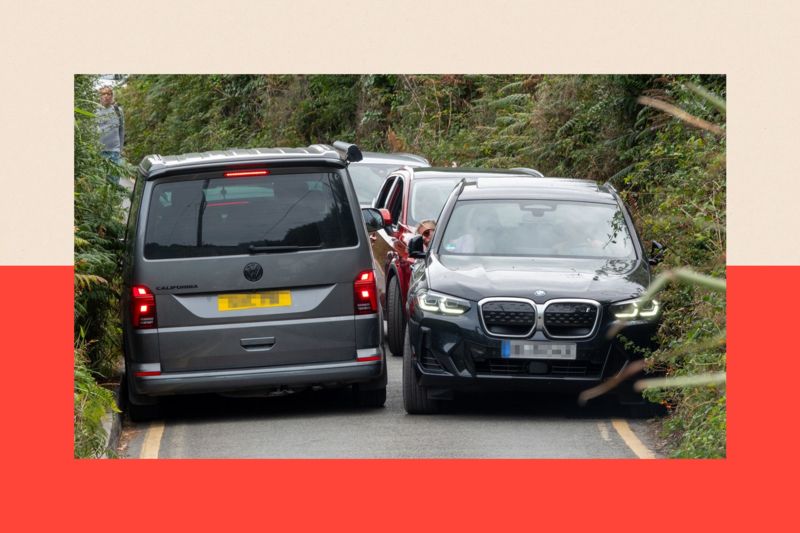
A couple years ago he also made a video about these trucks more broadly - https://www.youtube.com/watch?v=jN7mSXMruEo
What's truly maddening is how many of these vehicles which _do not_ meet European safety standards are _already_ in Europe. Walk around Hilversum in the Netherlands and you will see plenty of Dodge Rams (mostly 1500's, but there's even a 2500 Dually usually parked on the sidewalk ("pavement "for Brits) where my kids used to go to school). They're imported under "Individual Vehicle Approval" rules, exempting them from type safety requirements, and on top of that are almost always registered as "business vehicles" (you can tell from the V plate) which means they pay an absolute pittance in tax.
I moved here to get away from American kindercrushers (among other reasons) and I am profoundly concerned that Europe is being invaded by these machines.
(Edit) Worth noting is that a lot of Dutch street design is based on the idea that people _can_ share space with cars in dense, low speed environments, but that assumption flies out the window when the vehicles are so large you can't even see a kid walking or biking to school.
Further edit - source - https://www.motorfinanceonline.com/news/dodge-ram-registrati... 5,000 Dodge Rams imported in to Europe in 2023 alone.